LOUISVILLE, Ky. — In the early 2000s, Michelle Warfield worked at a factory, hauling heavy seats for Ford trucks on and off an assembly line. To suppress daily aches in her back and hips, her doctor prescribed opioid painkillers.
They worked for a bit. But by 2011, Warfield struggled to walk.
And “by that time, I was addicted,” said Warfield, now living in Shelbyville, Kentucky.
After she lost her health insurance, Warfield started buying pills on the street. She tried to quit several times, but the debilitating withdrawal — so bad she couldn’t get out of bed, she said — kept driving her back to drug use.
Until last year.
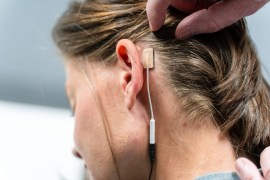
Through her church, Warfield learned about the NET device. It’s a cellphone-sized pack connected to gel electrodes placed near the ear that deliver low-level electrical pulses to the brain.
“Once I got set up on the device, within 30 minutes, I didn’t have any cravings” for opioids, Warfield said.
After three days on the device in August, she stopped using drugs altogether, she said.
Warfield’s treatment was paid for with her county’s opioid settlement dollars — money from pharmaceutical companies accused of fueling the overdose crisis.
State and local governments nationwide are receiving billions in opioid settlement cash over nearly two decades and are meant to spend it treating and preventing addiction.
Warfield wants them to allot a good chunk to the NET device, which costs counties about $5,500 a person. The pitch is gaining traction. NET Recovery, which makes the device, said it has signed about $1.2 million in contracts with more than a dozen counties and cities in Kentucky.
But some researchers and recovery advocates say the company’s rapid consumption of opioid dollars raises red flags. They see the NET device as the latest in a series of products that have been overhyped as the solution to the addiction crisis, preying on people’s desperation and capitalizing on the windfall of opioid settlements. Many of these products — from high-dose overdose reversal medications to body scanners for jails — have little evidence to back their lofty promises. That has not stopped sales representatives from repeatedly pitching elected officials or circulating ready-made templates to request settlement money for the companies’ products.
In fact, a device similar to NET called the Bridge gained popularity several years ago, receiving more than $215,000 in opioid settlement cash nationwide. But serious questions arose about the study backing its effectiveness, and the device is currently off the market.
NET Recovery’s activity “fits the national trends of these industry money grabs,” said Tricia Christensen, a national expert on opioid settlements based in Tennessee. The device “could be helpful for some,” she said. “But it’s being sold as a silver bullet.”
This year, 237 organizations working to end overdose — including Christensen’s consulting company — published a road map to guide officials in charge of opioid settlement money. In it, they called the NET device an example of problematic spending on unproven treatment.
Treating Withdrawal or Addiction
The FDA has cleared the NET device for a specific use: reducing drug withdrawal symptoms. It has not approved the device to treat addiction.
That’s a crucial distinction, said Eric Hulsey, executive director of the Institute for Research, Education and Training in Addictions. He co-authored a recent report evaluating the evidence on neuromodulation devices like NET.
“The term ‘treatment’ becomes confusing,” Hulsey said. “These devices were cleared to treat opioid withdrawal symptoms, not to treat an opioid use disorder.”
NET Recovery CEO Joe Winston said the company adheres to FDA rules and advertises the device only for withdrawal management. But “we are finding that physicians are prescribing this to folks for long-term behavior based on the results of our study.”
He’s referring to an October study that he co-authored and the company funded, in which researchers followed two groups of addiction patients in Kentucky for 12 weeks. The first group received the NET device for up to seven days, while the second group received a sham treatment.
The study found no significant difference between the groups’ outcomes. Participants who got the NET device were similarly likely to use illicit drugs after treatment as those who got the fake.
Hulsey, who was not affiliated with the study, said the takeaway is clear: “They didn’t find that was effective.”
A subgroup of participants who chose to use the device for more than 24 hours consecutively, however, went on to use illicit drugs less often than other participants.
As the researchers acknowledged in their paper, that subgroup might simply have been more motivated to engage with any form of treatment. The results don’t necessarily show that the device is making a difference, Hulsey said.
Rapid Growth
Winston had a different take. He said the success of the subgroup is “intriguing and outstanding.”
So outstanding, in fact, that the company this month is opening a brick-and-mortar location in Miami, where the device will be available to anyone who can pay $8,000 out-of-pocket. (The cost is higher for individuals than for county governments.) It has also applied for opioid settlement dollars from the state of Kentucky to conduct a larger research study and aims to bring the NET device into metro areas such as Louisville and Lexington.
Last year, NET Recovery hired a magistrate in Franklin County, Kentucky, to head up its operations in the state. (Magistrates function as county commissioners.) Kelly Dycus, who is also a mental health clinician, travels to different counties, extolling the benefits of the device and encouraging officials to contract with the company.
Her county awarded $75,000 to NET Recovery prior to her joining the company. Moving forward, Dycus said, she would recuse herself from any contract votes in her county.
Christensen, the national expert on opioid settlements, called Dycus’ new role “extremely strategic” for the company and “an obvious conflict of interest” for a public official.
Giving People Choice
More options for people to enter recovery is generally good, said Jennifer Twyman, who has a history of opioid addiction and now works with Vocal-KY, a nonprofit that advocates to end homelessness and the war on drugs.
But settlement funds are finite, she said, and when counties invest in the NET device, that leaves less money to support options like mental health treatment, housing, and transportation programs — critical for many people who use drugs.
“People slip through these big, huge gaps we have and they die,” Twyman said, pointing to photos of dead friends that line her office wall.
She added that people should have the option of taking medications such as methadone and buprenorphine — the gold standard for treating opioid addiction. National data shows only 1 in 4 people with opioid addiction get them.
Many people can’t afford them, find a doctor willing to prescribe them, or get transportation to appointments, Twyman said. There’s also discrimination against those who use medications, with detractors saying they’re not truly abstinent or clean.
Companies like NET Recovery sometimes lean into that stigma, Twyman said.
For instance, Scott County, Kentucky, jailer Derran Broyles — whom the company considers a key champion for its device — said in a public meeting to other county officials that medication treatment is just “swapping one drug for another.” It’s a common refrain from critics that many researchers and clinicians refute.
Winston told KFF Health News his company is supportive of all types of recovery but that the NET device can help the “underserved population” of people who don’t want medication.
Longtime addiction researcher Mark Greenwald has led studies for NET Recovery and consults for Indivior, one of the leading producers of medications for opioid use disorder. He said he sees value in both approaches. It just depends on whom you’re trying to treat.
For people injecting drugs or accustomed to high doses of fentanyl, who are more likely to return to using drugs after residential treatment, “I would hesitate to recommend the device,” he said. Abstinence-based approaches can increase their risk of dying. But for people who are “highly motivated to stay abstinent,” the NET device may be a good fit.
“Giving people choices is the right thing to do,” he said.
Community as Part of Recovery
Warfield, who has not used opioids since August, credits not just the NET device with her recovery but her community too.
“It’s not a miracle cure,” she said of the device. “You still have to manage your triggers, but it’s easier.”
She regularly attends individual and group therapy to address childhood trauma. She’s found close friends within her church and has reconnected with her daughter. She installed a car seat in her vehicle so she can drive her grandson to preschool.
Warfield explained her hope for opioid settlement money to reach others in her community simply: “I want people to get as much help as they can.”
KFF Health News is a national newsroom that produces in-depth journalism about health issues and is one of the core operating programs at KFF—an independent source of health policy research, polling, and journalism. Learn more about KFF.Some elements may be removed from this article due to republishing restrictions. If you have questions about available photos or other content, please contact NewsWeb@kff.org.