
Recent weeks have brought good news about vaccines, with studies indicating that flu vaccination reduces heart disease, shingles vaccines can prevent or slow dementia, and a single human papillomavirus shot protects a girl from cervical cancer for the rest of her life.
But in the upside-down world of Health and Human Services Secretary Robert F. Kennedy Jr., vaccines are on the ropes. A vaccine committee dominated by skeptics he chose for the panel voted 8-to-3 Friday to end a 34-year recommendation to inoculate newborns against hepatitis B, a practice that helped reduce childhood infections of the virus by 99%, from around 16,000 in 1991 to only seven in 2023.
While the committee went about its deliberations, the peril of abandoning vaccines was plain to see. The country’s worst year since 1992 for measles — an entirely vaccine-preventable illness — continued with flare-ups in Utah, Arizona, and South Carolina. A two-year outbreak of whooping cough, which vaccines can also check, has caused about 60,000 reported cases — including at least six infant deaths.
But neither of those diseases was discussed on the first day of the meeting by members of the Advisory Committee on Immunization Practices. The panel’s chartered purpose is to determine vaccination policies to counter such risks, but under Kennedy, it has focused on responding to doubts from vaccine skeptics and opponents.
Like previous gatherings of the committee, which was handpicked by Kennedy after he fired the panel’s 17 incumbent experts in June, the session was chaotically at odds with past practices of the Centers for Disease Control and Prevention. Kennedy has described the agency as a “cesspool of corruption.”
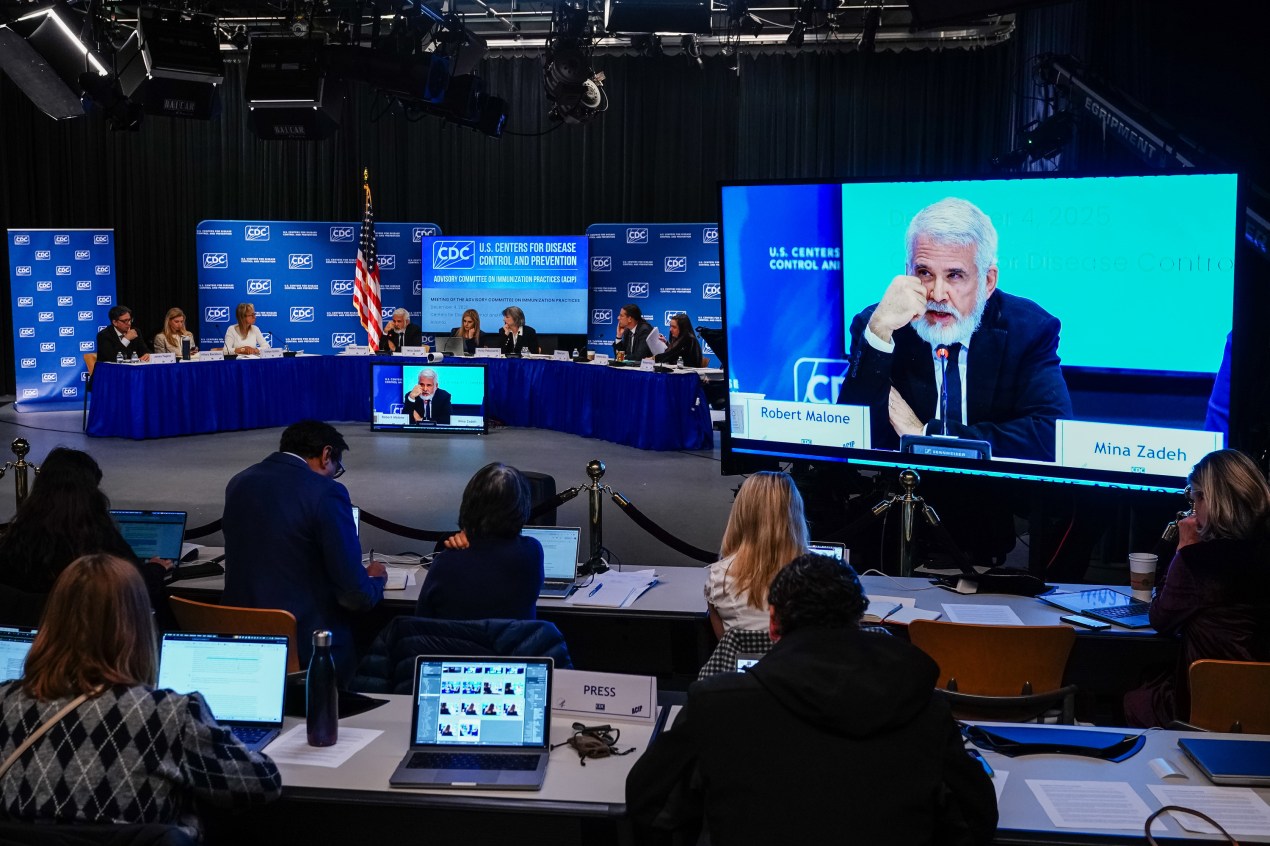
The committee’s chair, epidemiologist Martin Kulldorff, left three days before the meeting and was named to a senior HHS position. His successor, Kirk Milhoan, a pediatric cardiologist who has claimed that the mRNA technology used to make covid vaccines is “the biggest threat to humanity,” was on a plane or in Asia for most of the meeting, leaving Vice Chair Robert Malone holding the reins. Malone opposes vaccine mandates and became a darling of the anti-vaccine movement when he told podcast host Joe Rogan in 2021 that Americans were “basically being hypnotized” into taking the covid vaccine.
Typically, slides and data for the panel’s meetings are posted on the CDC’s website several days beforehand. This time they weren’t posted at all.
The committee’s working group that studied hepatitis B vaccines did not include recognized hepatitis experts. When a few panel members expressed reservations during the ACIP meeting, CDC hepatitis specialist Adam Langer was brought in to answer questions. He frowned on the proposed changes.
Surprising Choice of Experts
At 8 a.m. Dec. 4, the CDC finally listed the names of the meeting’s presenters. Aaron Siri, one of Kennedy’s former lawyers and a strident legal foe of vaccination, was set to headline Friday’s discussion of the pediatric immunization schedule.
Sen. Bill Cassidy, a Louisiana Republican and physician who cast a deciding vote for Kennedy to win confirmation to his job, said on the social platform X: “Aaron Siri is a trial attorney who makes his living suing vaccine manufacturers. He is presenting as if an expert on childhood vaccines. The ACIP is totally discredited. They are not protecting children.”
In replies to his post, some people demanded to know what Cassidy planned to do about it. While he has publicly criticized some of Kennedy’s moves on vaccines, the senator has made no visible effort to reverse them.
As the meeting began, Malone revealed that Vicky Pebsworth, a senior officer at the National Vaccine Information Center, a four-decade-old cornerstone of vaccine skepticism, was chairing a committee that is reviewing the entire childhood vaccine schedule. That’s the repository of ACIP recommendations that protect American children from measles, pertussis, influenza, tetanus, chickenpox, meningitis, and a host of other diseases.
Typically, seasoned CDC and FDA experts on vaccines and infectious disease present data about a disease and the options for its prevention before ACIP votes on a policy. Instead, Pebsworth, vaccine-skeptical climate scientist Cynthia Nevison, and businessperson Mark Blaxill, who helped lead another anti-vaccine group, presented the case — a negative one — on the hepatitis B vaccine on Dec. 4.
Sports medicine doctor Tracy Beth Høeg, who parlayed a year working with University of California-San Francisco epidemiologist Vinay Prasad, now the FDA’s vaccine chief, into a leading role at the agency, frequently chimed in. Nevison and Blaxill were co-authors of a 2021 autism study retracted for data misrepresentation and other problems.
Unsurprisingly, the picture they painted Dec. 4 suggested that the hepatitis B birth dose wasn’t necessary, and might be dangerous, notwithstanding years of scientific consensus to the contrary.
The presentations stunned Cody Meissner, an infectious disease specialist and one of the only vaccinologists on the CDC panel. “There were so many statements that I don’t agree with that it’s hard to be succinct,” he said.
Yvonne Maldonado, a Stanford University infectious disease specialist and one of the former ACIP members ejected in June, said she found it horrifying to watch unvetted presentations by nonexpert nonphysicians.
“Almost every statement made by this committee was misinformation, disinformation, or outright lies,” she said. “They are cherry-picking data, pulling up fringe papers, misunderstanding good papers. They are not the right people to be making decisions.”
Pebsworth said the committee was taking up the birth dose issue because of “pressure coming from stakeholder groups” — presumably including Kennedy and his allies. The U.S. is an “outlier” in its universal recommendation, she erroneously said.
In fact, the birth dose of the hepatitis B vaccine is given in 115 countries and is recommended by the World Health Organization. Many Western European countries limit the birth dose to targeted groups, however.
Arguments for the Birth Dose
Nevison said targeted measures to stop the virus in the 1980s, including promoting safer sex, increasing blood screening, and vaccinating the babies of hepatitis B-positive mothers, had achieved most of the reduction in cases since then. But most experts say the birth dose played a key role. And the virus remains a threat, with an estimated 640,000 carriers in the U.S.
The birth dose “is a safety net,” Meissner said. “It’s really for chronically infected mothers who for one reason or another do not get tested.”
“Where is the evidence of harm?” asked another panelist, psychiatrist Joseph Hibbeln.
In the years since the birth dose of hepatitis B vaccine was recommended, it has caused vanishingly few confirmed major side effects.
Blaxill, who 25 years ago helped advance the since-disproven theory that traces of mercury in vaccines were causing an epidemic of autism, said that hepatitis B vaccines were inadequately studied. He pointed to a study that showed high fevers in some children after the shot, which he said suggested brain inflammation.
Maldonado said that’s wrong. “I’ve seen thousands of children with fevers,” she said. “It’s not the same as encephalitis.”
Nevison said that a small number of vaccine court awards proved at least some harm by hepatitis B vaccinations. Reed Grimes, director of the Division of Injury Compensation Programs at the Health Resources and Services Administration, explained that an award does not necessarily signify proof of injury, but rather that the government decided not to contest a claim.
Speculation bloomed. Panelist Evelyn Griffin, an obstetrician, posited that rising cases of inflammatory bowel disease might be related to a medium — brewer’s yeast — used in the production of the hepatitis B vaccine. She did not cite a source for the idea.
Babies born with hepatitis B infections have a 90% chance of chronic liver infection later in life, and 25% of those with a chronic infection will die prematurely with chronic liver disease.
Panel members pushing to end the universal birth dose argued that blood tests of pregnant women should show who needs the shot. But only 35% of women who test positive receive all recommended follow-up care, and the virus can spread easily through contacts as common as a toothbrush or a bath towel. Ending the birth dose could result in nearly 500 deaths a year, according to a recent study.
The meeting was preceded by a heavy round of briefings for journalists and “prebunking” papers from established medical experts who view the new ACIP as a sounding board for anti-vaccine views — “inflating speculative risks while downplaying well-established vaccine benefits,” as three recent CDC officials wrote.
They noted that the hepatitis B birth dose is already optional, although doctors strongly recommend it. But recommending that it be a shared decision based on individual choice, as the ACIP voted Dec. 5, could add paperwork for doctors and introduce doubts in parents’ minds.
ACIP recommendations aren’t binding but have been used by health insurers in the past to establish coverage decisions. Federal agencies and private insurers will in most cases continue to pay for the hepatitis B vaccination if parents want it, said Andrew Johnson, who represented the Centers for Medicare & Medicaid Services during the meeting. But studies have shown that ambiguous advice leads to lower vaccination rates, said Kathryn Edwards, a Vanderbilt University vaccinologist.
Anti-vaccine activists have long targeted the hepatitis B birth dose. At one time they baselessly claimed it caused sudden infant death syndrome.
But within a decade of the universal dose implementation, the rate of SIDS had fallen by nearly half. That was thanks to an HHS-American Academy of Pediatrics’ “back to sleep” campaign, which urged parents to avoid suffocation risk by not letting their babies go to sleep on their stomachs.