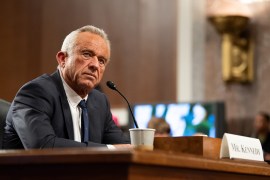
Senators Propose Offsets for House Mental Health Parity Bill To Increase Chance of Passage
Senate Health, Education, Labor and Pensions Committee Chair Edward Kennedy (D-Mass.) and Sen. Pete Domenici (R-N.M.) have proposed a new set of cost offsets to the House version of a mental health parity bill (HR 1424) that passed in March, CongressDaily reports. The offsets are part of a compromise parity measure that was sent to the House during the spring recess.Both the House and Senate have passed parity bills that would cost about $3 billion over 10 years. The House measure, which includes more requirements for what mental health services must be covered by insurers, would offset its costs through rebates paid by drug makers to state Medicaid programs and implementing a "controversial" proposal to prevent doctors from referring patients to physician-owned hospitals, CongressDaily reports. The additional House requirements and the two offsets are opposed by business interests. The Senate bill (S 558), which was created with input from business interests, has received their support.
Rep. Patrick Kennedy (D-R.I.), a lead sponsor of the House bill, declined to comment on specifics of the Senate recommendations but said, "We're in discussions to work out a compromise that maintains as much of the integrity of the House bill, while trying to pass something that will make it through the Senate." He added that the Senate is "being a great help" by suggesting "other pay-fors," noting, "the pay-fors that we used in the House are frankly not going to fly in the Senate, and everybody acknowledges that."
Give-and-Take
Rep. Kennedy said he is ready for a "give-and-take" conversation regarding several provisions of the House bill that would not be accepted by the Senate. According to CongressDaily, the House bill includes a mandate that health insurers cover all conditions listed in the Diagnostic and Statistical Manual of Mental Disorders, though many in the Senate would not accept such a mandate. Rep. Kennedy said other provisions, such as out-of-network parity and medical management, are seen as necessary by the House. Rep. Kennedy noted that the House position has been strengthened by several committee votes, as well as the floor vote on the bill. An aide for Sen. Kennedy said Senate sponsors of the bill could potentially concede some House requests (Johnson, CongressDaily, 4/2).
Letters to the Editor
The New York Times on Wednesday published letters to the editor responding to a March 30 opinion piece by columnist Sarah Kershaw. According to Kershaw, mental health parity "raises all sorts of tricky questions," such as, "Is an ailment a legitimate disease if you can't test for it?" It continued that "scientific advances may go a long way to help the parity cause" because the "biological and neurological connection lends strength to the notion that mental illnesses are as real and as urgent as physical illnesses and that there may, at long last, even be a cure in this lifetime, or the next." Kershaw wrote, "And if you can cure something, you can treat it, and there is a finite quality to that treatment -- and its costs" -- which could make insurers "more willing to pay for it." However, the piece concluded, "[I]n the halls of Congress, at least, the mind-body problem is far from resolved, particularly when it is uncertain who the next president will be" (Kaiser Daily Health Policy Report, 3/31).
Summaries of the letters to the editor appear below.
- Carolyn Robinowitz: "Mental illnesses are real illnesses that can be accurately diagnosed and effectively treated, with success rates that rival treatments for heart disease and cancer," according to Robinowitz, president of the American Psychiatric Association. Robinowitz writes that the "'mind-body problem'" Kershaw references is "not murky," noting that "the brain is part of the body, and mental illnesses have clear physical as well as behavioral indicators." The letter continues, "Research shows that parity can be achieved without a significant increase in cost," concluding, "It's time to end discrimination in health insurance coverage" (Robinowitz, New York Times, 4/2).
- George Northrup: The "case for mental health parity does not depend on resolving the age-old question of the mind-body relationship," because an "equally good reason to favor parity is that it would encourage therapy for millions whose untreated conditions" result in lost work productivity, accidents and neglected health, Northrup, president-elect of the New York State Psychological Association, writes. He adds, "While some conditions are indeed chronic (as in medicine), a large body of research supports the overall effectiveness of mental health treatment," noting that Kershaw's "generalization that mental illness typically 'never ends'" applies to "a small subset of those with emotional problems" (Northrup, New York Times, 4/2).
- Richard Gomberg: "Research has shown that many psychiatric diagnoses are at least as reliable and valid as medical diagnoses," according to a letter to the editor by Gomberg, a psychiatrist and a former congressional fellow working on mental health policy for the late Sen. Paul Wellstone (D-Minn.). In addition, "the idea that treating an illness is justified only when it can be tested for, would show up on autopsy or can be cured would be news to the millions of Americans" with chronic conditions that "would not fit those criteria," he writes. Gomberg adds that it is "not true that 'mental illness never ends'" because the "suffering of mental illness can be effectively treated." He concludes, "I feel extremely fortunate to be practicing medicine in Massachusetts, where we have a mental health parity law that allows me to offer my patients appropriate and compassionate care" (Gomberg, New York Times, 4/2).