Indian Health Service To Stop Use Of Mercury Dental Fillings By Next Year
The amalgam fillings were reclassified from low to moderate risk by the FDA in 2009. Meanwhile, the Department of Veterans Affairs looks to expand access to dental care for the roughly 2.3 million veterans who currently qualify.
AP:
Indian Health Service To End Use Of Mercury Dental Fillings
The federal agency that provides health care to Native Americans and Alaska Natives has announced it will phase out the use of dental fillings containing mercury. The Indian Health Service has used fillings, known as dental amalgams, that contain elemental mercury to treat decayed and otherwise damaged teeth for decades. Native American rights and industry advocates have called for an end to the practice, arguing it exposes patients who may not have access to private dentistry to a harmful neurotoxin. The use of mercury-containing amalgams, also known as “silver fillings” due to their appearance, has declined sharply since 2009 when the U.S. Food and Drug Administration reclassified the devices from low to moderate risk. (Lee Brewer and Peters, 2/15)
Military.com:
VA Launches Plan To Expand Dental Care Access For Veterans
The Department of Veterans Affairs is looking to overhaul how dental care is delivered to eligible veterans through the community care program. The VA posted a request for proposals Feb. 10 for a new dental care administrator to build and manage a nationwide network of community dental providers. The contract, once awarded, is intended to expand access to general and specialty dental care, preventive services and pharmacy support for the roughly 2.3 million veterans who currently qualify for VA dental benefits. (Wile, 2/16)
More health news about the Trump administration —
CIDRAP:
NIAID Staffers Ordered To Remove Biodefense, Pandemic Preparedness Language On Website
Staff members at the US National Institute of Allergy and Infectious Diseases (NIAID) have been told to delete the words “biodefense” and “pandemic preparedness” from the institute’s website, a move that experts say will hobble the United States’ ability to respond to future infectious disease threats, Nature reported late last week. The journal said the directives were outlined in emails it obtained, but it didn’t name the person who sent them. It said four NIAID staffers spoke to Nature on the condition of anonymity because the institute didn’t authorize them to speak to media. (Van Beusekom, 2/16)
NBC News:
At National Institutes Of Health, Many Director Positions Sit Open
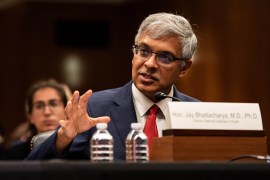
The National Institutes of Health has, in large part, managed to withstand the Trump administration’s attempts to slash its budget and upend how it distributes grants, thanks to decisions from the courts and Congress. But the agency now faces a growing vacuum in leadership in its top ranks — one that offers the administration a highly unusual opportunity to reshape NIH to its vision. Of the 27 institutes and centers that make up NIH, 16 were missing permanent directors as of Friday, when staff received news of the latest departure. (Bendix, 2/15)
Bloomberg:
Cost Of Trump's Coal Push Plays Out In Dollars, Noise And Health
Chad Schmucker, 71, lives in Port Sheldon Township on the East shore of Lake Michigan, an area where dunes meet forest and water draws boaters in summer. It would be his dream retirement spot except that it’s just south of the J.H. Campbell coal plant, which spews pollutants and makes so much noise that at times his wife can’t sleep. Summer brings the sound of tractors pushing coal, the mechanical churn carrying across the shoreline. Then there’s the grit. (Kaufman, Roston and Green, 2/14)
KFF Health News:
Trump Required Hospitals To Post Their Prices For Patients. Mostly It’s The Industry Using The Data
Republicans think patients should be shopping for better health care prices. The party has long pushed to give patients money and let consumers do the work of reducing costs. After some GOP lawmakers closed out 2025 advocating to fund health savings accounts, President Donald Trump introduced his Great Healthcare Plan, which calls for, among other policies, requiring providers and insurers to post their prices “in their place of business.” (Tahir, 2/17)
On the partial shutdown of the federal government —
The Guardian:
Limited Government Shutdown Likely To Linger For At Least 10 Days As Congress Takes Break
The latest shutdown is unlikely to be lifted soon – US lawmakers have left Washington DC for a 10-day break. However, Republican leaders in Congress have said that negotiations would continue, and that members should be ready to return to Washington subject to an agreement. (Helmore, 2/14)
Roll Call:
After Stalled Health Deal, Voters Want Congress To Deliver
As Congress spent months arguing over COVID-19-era enhanced premium tax credits that many people on the Affordable Care Act used to subsidize their health insurance, a relatively narrow debate over a single policy grew into a much broader and more complicated discussion about how to lower health care costs. Concerns about those costs are a top issue for voters ahead of this year’s midterms. But whether Congress can meaningfully address the issue and how candidates communicate that idea to voters depends on the type of cost increases and what is driving them. (Raman and DeGroot, 2/13)
In related news about civil rights and equity in America —
The New York Times:
Jesse Jackson, Civil Rights Leader Who Sought the Presidency, Dies at 84
The Rev. Jesse Jackson's death was confirmed by his family in a statement, which said that Mr. Jackson “died peacefully,” but did not give a cause. Mr. Jackson was hospitalized in November for treatment of a rare and particularly severe neurodegenerative condition, progressive supranuclear palsy (PSP), according to the advocacy organization he founded, the Rainbow PUSH Coalition. In 2017, he announced that he had Parkinson’s disease, which in its early stages can produce similar effects on bodily movements and speech. (Applebome, 2/17)