


Latest KFF Health News Stories

Patients Divided Over Alzheimer’s Drug: Is It a ‘Risk I’m Willing to Take’ or Just a ‘Magic Pill’?
Medicare has proposed limiting coverage of Aduhelm, the costly new drug to treat Alzheimer’s disease, and several prominent groups representing patients and their families are pressing the program to make it more widely available. But among individuals facing the disease, the outlook is more nuanced.

Watch: California’s Top Health Adviser on Learning to Live With Covid
KHN Senior Correspondent Samantha Young joined California Health and Human Services Secretary Mark Ghaly for an engaging conversation about how California moves forward in an environment in which covid persists, but at more manageable levels.

Poco más del 57% de los adolescentes de 12 a 17 años y el 62% de los jóvenes de 18 a 24 años están completamente vacunados. Para estas franjas de edad covid también puede ser mortal.
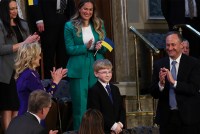
$35 Insulin Cap Is Welcome, Popular, and Bipartisan. But Congress May Not Pass It Anyway.
Spun off from the ailing but not-quite-dead Build Back Better legislation, a popular proposal to cap out-of-pocket insulin costs at $35 a month faces tough political realities that could kill it.
When Teens Blow Off Parents’ Pleas to Get Vaccinated, the Consequences Can Be Deadly
Kennedy Stonum, a 17-year-old high school junior, resisted getting vaccinated against covid-19, as did 20-year-old Tyler Gilreath, whose mother had nagged him for months to get the shots. Both died.

California Governor’s Big Promises on Drug Prices Are Slow to Materialize
Gov. Gavin Newsom has launched several initiatives to cut rising drug prices, but the savings haven’t been as monumental as he promised. And his plan to have California make its own generic drugs hasn’t gotten off the ground.
KHN’s ‘What the Health?’: A Health-Heavy State of the Union
President Joe Biden spent a large portion of his first State of the Union address talking about foreign affairs, but he also spent time on an array of health topics, including mental health, nursing home regulation, and toxic burn pits. Also this week, the administration unveiled a strategy to address the covid pandemic going forward. Alice Miranda Ollstein of Politico, Amy Goldstein of The Washington Post, and Sarah Karlin-Smith of the Pink Sheet join KHN’s Julie Rovner to discuss these issues and more. Plus, for extra credit, the panelists recommend their favorite health policy stories of the week they think you should read, too.

La medicación para prevenir el VIH debe ser gratis, pero las aseguradoras siguen cobrándola
Una norma federal estableció que los pacientes no debían pagar por la medicación para prevenir el VIH. Pero las aseguradoras siguen enviando facturas por los fármacos y servicios médicos asociados.

Seeking to Shift Costs to Medicare, More Employers Move Retirees to Advantage Plans
Private and public employers are increasingly using the government’s Medicare Advantage program as an alternative to their existing retiree health plan and traditional Medicare coverage. As a result, the federal government is paying the “overwhelming majority” of medical costs, according to an industry analyst.
HIV Preventive Care Is Supposed to Be Free in the US. So, Why Are Some Patients Still Paying?
The Department of Labor issued rules in July clarifying that health plans need to cover the costs of prescription drugs proven to prevent HIV infection, along with related lab tests and medical appointments, at no cost to patients. More than half a year later, the erroneous billing continues.

Calls to Overhaul Methadone Distribution Intensify, but Clinics Resist
The pandemic has shown that loosening the strict regulations on distributing methadone helps people recovering from addiction stay in treatment. But clinics with a financial stake in keeping the status quo don’t want to make permanent changes.

Biden Pledges Better Nursing Home Care, but He Likely Won’t Fast-Track It
CMS chief Chiquita Brooks-LaSure says the agency reserves its power to quickly institute new regulations for “absolute emergencies.” On staffing, nursing home residents might need to wait years to see any real change.

To Be One in a Million: ‘Who Thinks It’s Going to Be You?’
Stan Thomas’ wife, Monica Melkonian, was one of only nine people in the U.S. confirmed to have died from vaccine-induced immune thrombotic thrombocytopenia, a rare side effect associated with the Johnson & Johnson covid vaccine. For the first time, Thomas shares her story of how excited she was to get the shot, how she died, and why he remains firmly pro-vaccine.

Fact Check: Biden Sets High Bar in 1st State of the Union Speech
What a difference a year makes. The speech was delivered to a largely unmasked crowd of lawmakers, justices, and Cabinet members in the House chamber.

Covid Expert Joins Exodus Into Business, Where Science Parlays Into Profits
Like others in academia or government who’ve served as public health advisers during the pandemic, Dr. Michael Mina traded his university role for a commercial venture. He recently took a top job at eMed, a startup that charges a premium price for monitoring at-home covid tests. Can experts do well by trying to do good?

Desperate for Cash: Programs for People With Disabilities Still Not Seeing Federal Funds
Almost a year after the American Rescue Plan Act allocated what could amount to $25 billion to home and community-based services run by Medicaid, many states have yet to access much of the money due to delays and red tape.

Dangerous Levels of Lead Were Found in the Water of About Half the Schools Tested in Montana
Officials testing water found high lead levels in more than 100 of the state’s nearly 600 school buildings. But as of mid-February, half the state’s schools had yet to provide samples.
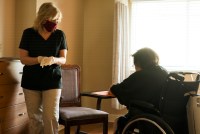
Biden’s Promise of Better Nursing Home Care Will Require Many More Workers
The president wants to set minimum staffing levels for the beleaguered nursing home industry. But, given a lack of transparency surrounding the industry’s finances, it’s a mystery how facilities will shoulder the added costs.
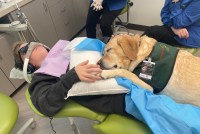
Perros ayudan a que los pacientes no sientan miedo en el dentista. Pero hay controversia
Cada vez hay más perros que alivian la ansiedad en los consultorios de dentistas. Pero hay pocas regulaciones sobre los animales en entornos médicos.

Vacunados con J&J, reforzados con ARNm, y pensando en la tercera dosis
Cerca de 17 millones de personas que recibieron la vacuna de Johnson & Johnson contra covid se preguntan cuántas dosis necesitan.