The Host

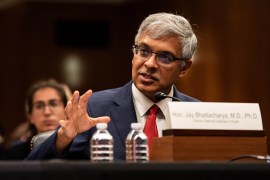
The Trump administration this week missed a deadline to nominate a new director for the Centers for Disease Control and Prevention. Without a nominee, current acting Director Jay Bhattacharya — who is also the director of the National Institutes of Health — has to give up that title, leaving no one at the helm of the nation’s primary public health agency.
Meanwhile, a week after one federal judge blocked changes to the childhood vaccine schedule made by the Department of Health and Human Services, another blocked a proposed ban on gender-affirming care for minors.
This week’s panelists are Julie Rovner of KFF Health News, Rachel Cohrs Zhang of Bloomberg News, Lizzy Lawrence of Stat, and Shefali Luthra of The 19th.
Panelists



Among the takeaways from this week’s episode:
- A federal judge ruled against the Trump administration’s declaration intended to limit trans care for minors, though the ruling’s practical effects will depend on whether hospitals resume such care. And a key member of the remade federal vaccine advisory panel resigned as the panel’s activities — and even membership — remain in legal limbo.
- Two senior administration health posts remain unfilled, after President Donald Trump missed a deadline to fill the top job at the Centers for Disease Control and Prevention — and the Senate made little progress on confirming his nominee for surgeon general.
- The percentage of international graduates from foreign medical schools who match into U.S. residency positions has dropped to a five-year low. That’s notable given immigrants represent a quarter of physicians, many of them in critical but lower-paid specialties such as primary care — particularly in rural areas. Meanwhile, new surveys show that more than a quarter of labs funded by the National Institutes of Health have laid off workers and that federal research funding cuts have had a disproportionate effect on women and early-career scientists.
- And new data shows the number of abortions in the United States stayed relatively stable last year, for the second straight year — largely due to telehealth access to abortion care. And a vocal opponent of abortion in the Senate, with his eyes on a presidential run, introduced legislation to effectively rescind federal approval for the abortion pill mifepristone.
Also this week, Rovner interviews Georgetown Law Center’s Katie Keith about the state of the Affordable Care Act on its 16th anniversary.
Email Sign-Up
Subscribe to KFF Health News' free Morning Briefing.
Plus, for “extra credit,” the panelists suggest health policy stories they read this week that they think you should read, too:
Julie Rovner: Stat’s “The Potential Loophole in Trump’s Plan To Get Other Countries To Pay More for Drugs,” by John Wilkerson.
Shefali Luthra: NPR’s “Yep. A Mom’s COVID Shot During Pregnancy Protects Her Baby, a Large Study Finds,” by Tara Haelle.
Lizzy Lawrence: The Atlantic’s “The Meme-Washing of RFK Jr.,” by Nicholas Florko.
Rachel Cohrs Zhang: The Boston Globe’s “‘We’re on the Inside Now’: Meet the Man Building a Political Empire Behind RFK Jr.,” by Tal Kopan.
Also mentioned in this week’s podcast:
- Stat’s “National Survey of NIH-Funded Researchers Shows Precarious State of U.S. Science — ‘This Is Like the Titanic,’” by Jonathan Wosen.
- KFF Health News’ “Rising Health Costs Push Some Middle-Aged Adults To Skip the Doc Until Medicare,” by Sam Whitehead.
- Guttmacher’s “Full-Year 2025 Estimates Show Overall Stability in Abortion Incidence, Decreased Travel and Increased Telehealth Provision,” by Isaac Maddow-Zimet and Kimya Forouzan.
- United for Medical Research’s “2026 Update: NIH’s Role in Sustaining the U.S. Economy.”
[Editor’s note: This transcript was generated using both transcription software and a human’s light touch. It has been edited for style and clarity.]
Julie Rovner: Hello, from KFF Health News and WAMU Public Radio in Washington, D.C. Welcome to What the Health? I’m Julie Rovner, chief Washington correspondent for KFF Health News, and I’m joined by some of the best and smartest reporters covering Washington. We’re taping this week on Thursday, March 26, at 10 a.m. As always, news happens fast, and things might have changed by the time you hear this. So, here we go.
Today, we are joined via video conference by Rachel Cohrs Zhang of Bloomberg News.
Rachel Cohrs Zhang: Hi, everybody.
Rovner: Shefali Luthra of The 19th.
Shefali Luthra: Hello.
Rovner: And Lizzy Lawrence of Stat News.
Lizzy Lawrence: Hello.
Rovner: Later in this episode we’ll have my interview with Katie Keith of Georgetown University about the state of the Affordable Care Act as it turns 16 — old enough to drive in most states. But first, this week’s news.
So, it has been another busy week at the Department of Health and Human Services. Last week, a federal judge in Massachusetts blocked the department’s vaccine policy, ruling it had violated federal administrative procedures regarding advisory committees. This week, a federal judge in Portland, Oregon, ruled the department also didn’t follow the required process to block federal reimbursement for transgender-related medical treatment. The case was brought by 21 Democratic-led states. Where does this leave the hot-button issue of care for transgender teens? Shefali, you’ve been following this.
Luthra: I mean, I think it’s still really up in the air. A lot of this depends on how hospitals now respond — whether they feel confident in the court’s decision, having staying power enough to actually resume offering services. Because a lot of them stopped. And so that’s something we’re still waiting to actually see how this plays out in practice. Obviously, it’s very symbolic, very legally meaningful, but whether this will translate into changes in practical health care access, I think, is an open question still.
Rovner: Yeah, we will definitely have to see how this one plays out — and, obviously, if and when the administration appeals it. Well, speaking of that vaccine ruling from last week — which, apparently, the administration has not yet appealed, but is going to — one of the most contentious members of that very contentious Advisory Committee on Immunization Practices has resigned. Dr. Robert Malone, a physician and biochemist, said he didn’t want to be part of the “drama,” air quotes. But he caused a lot of the drama, didn’t he?
Cohrs Zhang: He has been pretty outspoken, and I think he isn’t like a Washington person necessarily — isn’t somebody who’s used to, like, being on a public stage and having your social media posts appear in large publications. So I think it’s questionable, like, whether he had a position to resign from. I think his nomination was stayed, too. But I think it is … the back-and-forth, I think, there is a good point that this limbo can be frustrating for people when meetings are canceled at the last minute, and people have travel plans, and it does … just changes the calculus for kind of making it worth it to serve on one of these advisory committees.
Rovner: And I’m not sure whether we mentioned it last week, but the judge’s ruling not only said that the people were incorrectly appointed to ACIP, but it also stayed any meetings of the advisory committee until there is further court action, until basically, the case is done or it’s overruled by a higher court. So … vaccine policy definitely is in limbo.
Well, meanwhile, yesterday was the deadline for the administration to nominate someone to head the Centers for Disease Control and Prevention since Susan Monarez was abruptly dismissed, let go, resigned, whatever, late last summer. Now that that deadline has passed, it means that acting Director Jay Bhattacharya, who had added that title to his day job as head of the National Institutes of Health, can no longer remain acting director of CDC. Apparently, though he’s going to sort of remain in charge, according to HHS spokespeople, with some authorities reverting to [Health and Human Services] Secretary [Robert F.] Kennedy [Jr.]. What’s taking so long to find a CDC director?
To quote D.C. cardiologist and frequent cable TV health policy commentator Jonathan Reiner, “The problem here is that there’s no candidate who’s qualified, MAHA acceptable, and Senate confirmable. Those job requirements are mutually exclusive.” That feels kind of accurate to me. Is that actually the problem? Rachel, I see you smiling.
Cohrs Zhang: Yeah. I think it is tough to find somebody who checks all of those boxes. And though it has been 210 days since the clock has started, I would just point out that there has been a significant leadership shake-up at HHS, like among the people who are kind of running this search, and they came in, you know, not that long ago. It’s only been, you know, a month and a half or so. So I think there certainly have been some new faces in the room who might have different opinions. But I think it isn’t a good look for them to miss this deadline when they have this much notice. But I think there’s also, like, legal experts that I’ve spoken with don’t think that there’s going to be a huge day-to-day impact on the operations of the CDC. It kind of reminds me of that office where there’s, like, an “assistant to the regional manager vibe” going on, where, like, Dr. Bhattacharya is now acting in the capacity of CDC director, even though he isn’t acting CDC director anymore. So, I think I don’t know that it’ll have a huge day-to-day impact, but it is kind of hanging over HHS at this point, as they are already struggling with the surgeon general nomination, to get that through the Senate. So it just creates this backlog of nominations.
Rovner: I’ve assumed they’ve floated some names, let us say, one of which is Ernie Fletcher, the former governor of Kentucky, also a former member of the House Energy and Commerce health subcommittee, with some certainly medical chops, if not public health chops. I think the head of the health department in Mississippi. There was one other who I’ve forgotten, who it is among the names that have been floated …
Cohrs Zhang: Joseph Marine. He’s a cardiologist at Johns Hopkins, who has — is kind of like in the kind of Vinay Prasad world of critics of the FDA and, like, CDC’s covid booster strategy.
Rovner: And yet, apparently, none of them could pass, I guess, all three tests. Do we think it might still be one of them? Or do we think there are other names that are yet to come?
Cohrs Zhang: Our understanding is that there are other candidates whose names have not become public, and I think there’s also a possibility they don’t choose any of these candidates and just drag it on for a while because, at this point, like, I don’t know what the rush is, now that the deadline is passed.
Lawrence: Yeah, is there another deadline to miss?
Cohrs Zhang: I don’t think so.
Lawrence: I think this was the only one.
Cohrs Zhang: This was the big one that they now have. It’s vacant, but it was vacant before as well. Like, I think, earlier in the administration, when Susan Monarez was nominated.
Rovner: But she, well … that’s right, she was the “acting,” and then once she was nominated, she couldn’t be the acting anymore.
Cohrs Zhang: Yeah.
Rovner: So I guess it was vacant while she was being considered.
Cohrs Zhang: It was. So it’s not an unprecedented situation, even in this administration. It’s just not a good look, I guess. And I think there is value in having a leader that can interface with the White House and with different leaders, and just having a direction for the agency, especially because it’s in Atlanta, it’s a little bit more removed from the everyday goings-on at HHS in general. So I think there’s definitely a desire for some stability over there.
Rovner: And we have measles spreading in lots more states. I mean, every time I … open up my news feeds, it’s like, oh, now we have measles, you know, in Utah, I think, in Montana. Washtenaw County, Michigan, had its first measles case recently. So this is something that the CDC should be on top of, and yet there is no one on top of the CDC. Well, Rachel, you already alluded to this, but it is also apparently hard to find a surgeon general who’s both acceptable to MAHA and Senate confirmable, which is my way of saying that the Casey Means nomination still appears to lack the votes to move out of the Senate, Health, Education, Labor & Pensions Committee. Do we have any latest update on that?
Cohrs Zhang: I think the latest update, I mean, my colleagues at Bloomberg Government just kind of had an update this week that they’re still not to “yes” — like, there are some key senators that still haven’t announced their positions publicly. So I think a lot of the same things that we’ve been hearing … like Sens. Susan Collins and Lisa Murkowski and Bill Cassidy obviously have not stated their positions publicly on the nomination. Sen. Thom Tillis, who you know is kind of in a lame-duck scenario and doesn’t really have anything to lose, has, you know, said he’s not really made a decision. So I think they’re kind of in this weird limbo where they, like, don’t have the votes to advance her, but they also have not made a decision to pull the nomination at this time. So either, I think, they have to push harder on some of these senators, and I think senators see this as a leverage point that I don’t know that a lot of — that all of the complaints are about Dr. Means specifically, but anytime that there is frustration with the wider department, then this is an opportunity for senators to have their voice heard, to … potentially extract some concessions. And so there’s a question right now, are they going to change course again for this position, or are they going to, you know, sit down at the bargaining table and really cut some deals to advance her nomination? I just don’t think we know the answer to that yet.
Rovner: Yeah, it’s worth reminding that, frequently, nominations get held up for reasons that are totally disconnected from the person involved. We went — I should go back and look this up — we went, like, four years in two different administrations without a confirmed head of the Centers for Medicare & Medicaid Services because members of Congress were angry about other things, not because of any of the people who had actually been nominated to fill that position. But in this case, it does seem to be, I think, both Casey Means and, you know, her connection to MAHA, and the fact that among those who haven’t declared their positions yet, it’s the chairman of the committee, Bill Cassidy, who’s in this very tight primary to keep his seat. So we will keep on that one.
Also, meanwhile, HHS continues to push its Make America Healthy Again priority. Secretary Kennedy hinted on the Joe Rogan podcast last month that the FDA will soon take unspecified action to make customized peptides easier to obtain from compounding pharmacies. These mini-proteins are part of a biohacking trend that many MAHA adherents say can benefit health, despite their not having been shown to be safe and effective in the normal FDA approval process. The FDA has also formally pulled a proposed rule that would have banned teens from using tanning beds. We know that the secretary is a fan of tanning salons, even though that has been shown to cause potential health problems, like skin cancer. Lizzy, is Kennedy just going to push as much MAHA as he can until the courts or the White House stops him?
Lawrence: I guess so. I mean, we do have this new structure at HHS now that’s trying to — clearly … there are warring factions with the MAHA agenda and the White House really trying to focus more on affordability and less on … vaccine scrutiny and the medical freedom movement that is really popular among Kennedy’s supporters. … I’m very curious about what’s going to happen with peptides, because it’s a sign of Kennedy’s regulatory philosophy, where there’s some products that are good and some that are bad. It’s very atypical, of course, for …
Rovner: And that he gets to decide rather than the scientists, because he doesn’t trust the scientists.
Lawrence: Right. Right. But there has been, I mean, the FDA has kind of been pretty severe on GLP-1 compounders Hims & Hers, so it’ll be interesting to see, you know, how much Kennedy is able to exert his will here, and how much FDA regulators will be able to push back and make their voices heard.
Rovner: My favorite piece of FDA trivia this week is that FDA is posting the jobs that are about to be vacant at the vaccine center, and one of the things that it actually says in the job description is that you don’t have to be immunized. I don’t know if that’s a signal or what.
Lawrence: Yeah, I think it said no telework, which Vinay Prasad famously was teleworking from San Francisco. So, yeah, I don’t know. But this was, I think it was for his deputy, although I’m sure, I mean, they do need a CBER [Center for Biologics Evaluation and Research] director as well.
Rovner: Yeah, there’s a lot of openings right now at HHS. All right, we’re gonna take a quick break. We will be right back.
So Monday was the 16th anniversary of the signing of the Affordable Care Act, which we will hear more about in my interview with Katie Keith. But I wanted to highlight a story by my KFF Health News colleague Sam Whitehead about older Americans nearing Medicare eligibility putting off preventive and other care until they qualify for federal coverage that will let them afford it. For those who listened to my interview last week with Drew Altman, this hearkens back to one of the big problems with our health system. There are so many quote-unquote “savings” that are actually just cost-shifting, and often that cost-shifting raises costs overall. In this case, because those older people can no longer afford their insurance or their deductibles, they put off care until it becomes more expensive to treat. At that point, because they’re on Medicare, the federal taxpayer will foot a bill that’s even bigger than the bill that would have been paid by the insurance company. So the savings taxpayers gained by Congress cutting back the Affordable Care Act subsidies are lost on the Medicare end. Is this cost-shifting the inevitable outcome of addressing everything in our health care system except the actual prices of medical care?
Cohrs Zhang: I think it’s just another example of how people’s behavior responds to these weird incentives. And I think we’re seeing this problem, certainly among early retirees, exacerbated by the expiration of the Affordable Care Act subsidies that we’ve talked about very often on this podcast, because it affects these higher earners, and it can dramatically increase costs for coverage. And I think people just hope that they can hold on. But again, these statutory deadlines that lawmakers make up sometimes, not with a lot of forethought or rational reasoning, they have consequences. And obviously, the Medicare program continues to pay beyond age 65 as well. And I think it’s just another symptom of what the administration talks about when they talk about emphasizing, you know, preventative care and addressing chronic conditions — like, that is a real problem. And, yeah, I think we’re going to see these problems in this population continue to get worse as more people forgo care, as it becomes more expensive on the individual markets.
Luthra: I think you also make a good point, though, Julie, because the increase in costs and cost sharing is not limited to people with marketplace plans, right? Also, people with employer-sponsored health care are seeing their out-of-pocket costs go up. Employers are seeing what they pay for insurance go up as well. And there absolutely is something to be said about it’s been 16 years since the Affordable Care Act passed, we haven’t really had meaningful intervention on the key source of health care prices, right? Hospitals, providers, physicians. And it does seem, just thinking about where the public is and the politics are, that there is possibly appetite around this. You see a lot of talk about affordability, but a lot of this feels, at least as an observer, very focused on insurance, which makes sense. Insurance is a very easy villain to cast. But I think you’ve raised a really good point: that addressing these really potent burdens on individuals and eventually on the public just requires something more systemic and more serious if we actually want to yield better outcomes.
Rovner: Yeah, there’s just, there’s so much passing the hat that, you know, I don’t want to do this, so you have to do this. You know, inevitably, people need health care. Somebody has to pay for it. And I think that’s sort of the bottom line that nobody really seems to want to address.
Well, the other theme of 2026 that I feel like I keep repeating is what funding cutbacks and other changes are doing to the future of the nation’s biomedical and medical workforces. Last week was Match Day. That’s when graduating medical school seniors find out if and where they will do their residency training. One big headline from this year’s match is that the percentage of non-U.S. citizen graduates of foreign medical schools matching to a U.S. residency position fell to a five-year low of 56.4%. That compares to a 93.5% matching rate for U.S. citizen graduates of U.S. medical schools. Why does that matter? Well, a quarter of the U.S. physician workforce are immigrants, and they are disproportionately represented, both in lower-paid primary care specialties, particularly in rural areas, both of which U.S. doctors tend to find less desirable. This would seem to be the result of a combination of new fees for visas for foreign professionals that we’ve talked about, a general reduction in visa approvals, and some people likely not wanting to even come to the U.S. to practice. But that rural health fund that Republicans say will revitalize rural health care doesn’t seem like it’s really going to work without an adequate number of doctors and nurses, I would humbly suggest.
Lawrence: Yeah, absolutely. I mean, it’s patients that suffer, right? I mean, you need the people doing the work. And so I think that the impacts will start being felt sooner rather than later. That is something that hopefully people will start to feel the pain from.
Rovner: I feel like when people think about the immigrant workforce, they think about lower-skilled, lower-paid jobs that immigrants do, and they don’t think about the fact that some of the most highly skilled, highly paid jobs that we have, like being doctors, are actually filled by immigrants, and that if we cut that back, we’re just going to exacerbate shortages that we already know we have.
Luthra: And training doctors takes, famously, a very long time. And so if you are disincentivizing people from coming here to practice, cutting off this key source of supply, it’s not as if you can immediately go out and say, Here, let’s find some new people and make them doctors. It will take years to make that tenable, make that attractive, and make that a reality. And it just seems, to Lizzy’s point, that even in the scenario where that was possible — which I would be somewhat doubtful; medicine is a hard and difficult career; it’s not like you can make someone want to do that overnight — patients will absolutely see the consequences. I don’t know if it’s enough to change how people think about immigration policy and ways in which we recruit and engage with immigrant workers, but it’s absolutely something that should be part of our discussion.
Rovner: Yeah, and I think it’s been left out. Well, meanwhile, over at the National Institutes of Health, a survey of 1,000 researchers by your colleagues at Stat, Lizzy, found that more than a quarter have laid off laboratory workers. More than 2 in 5 have canceled research, and two-thirds have counseled students to consider careers outside of academic research. A separate study published this week found that women and early-career scientists have been disproportionately affected by the NIH cuts, even though most of the money goes to men and to later-career scientists. As I keep saying, this isn’t just about the future of science. Biomedical research is a huge piece of the U.S. economy. Earlier this month, the group United for Medical Research updated its annual estimates about NIH, finding that every dollar invested produced $2.57 for the economy. Concerned members of Congress from both parties last week at an appropriations hearing got NIH Director Jay Bhattacharya to again promise to push all the money that they appropriated out the door. But it’s not clear whether it’s going to continue to compromise the future workforce. I feel like, you know, we talk about all these missing people and nomination stuff, but we’re not really talking a lot about what’s going on at the National Institutes of Health, which is a, you know, almost $50 billion-a-year enterprise.
Lawrence: Right. In some labs, the damage has already been done. You know, even if Dr. Bhattacharya [follows through], try spending all the money that has been appropriated. There are young researchers that have been shut out and people that have had to choose alternative career paths. And I think this is one of those things that’s difficult politically or, you know, in the public consciousness, because it is hard to see the immediate impacts it’s measured. And I think my colleague Jonathan wrote [that] breakthroughs are not discovered things, you know. So it’s hard to know what is being missed. But the immediate impact of the workforce and not missing this whole generation of scientists that has decided to go to another country or go to do something else, those impacts will be felt for years to come.
Rovner: Yeah, this is another one where you can’t just turn the spigot back on and have it immediately refill.
Finally, this week, there is always reproductive health news. This week, we got the Alan Guttmacher Institute’s annual abortion estimates for the year 2025, which both sides of the debate consider the most accurate, and it found that for the second year in a row, the number of abortions in the U.S. remained relatively stable, despite the fact that it’s outlawed or seriously restricted in nearly half the states. Of course, that’s because of the use of telehealth, which abortion opponents are furiously trying to get stopped, either by the FDA itself or by Congress. Last week, anti-abortion Sen. Josh Hawley of Missouri introduced legislation that would basically rescind approval for the abortion pill mifepristone. But that legislation is apparently giving some Republicans in the Senate heartburn, as they really don’t want to engage this issue before the midterms. And, apparently, the Trump administration doesn’t either, given what we know about the FDA saying that they’re still studying this. On the other hand, Republicans can’t afford to lose the backing of the anti-abortion activists either. They put lots of time, effort, and money into turning out votes, particularly in times like midterms. How big a controversy is this becoming, Shefali?
Luthra: This is a huge controversy, and it’s so interesting to watch this play out. When I saw Sen. Hawley’s bill, I mean, that stood out to me as positioning for 2028. He clearly wants to be a favorite among the anti-abortion movement heading into a future presidential primary. But at the same time, this is teasing out really potent and powerful dynamics among the anti-abortion movement and Republican lawmakers, exactly what you said. Republican lawmakers know this is not popular. They do not want to talk about abortion, an issue at which they are at a huge disadvantage with the public. Susan B Anthony List and other such organizations are trying to make the argument that if they are taken for granted, as they feel as if they are, that will result in an enthusiasm gap. Right? People will not turn out. They will not go door-knocking, they won’t deploy their tremendous resources to get victories in a lot of these contested, particularly Senate and House, races. And obviously, the president cares a lot about the midterms. He’s very concerned about what happens when Democrats take control of Congress. But I think what Republicans are wagering, and it’s a fair thought, is that where would anti-abortion activists go? Are they going to go to Democrats, who largely support abortion rights? And a lot of them seem confident that they would rather risk some people staying home and, overall, not alienating a very large sector of the American public that does not support restrictions on abortion nationwide, especially those that many are concerned are not in keeping with the actual science.
Rovner: Yeah, I think the White House, as you said, would like to make this not front and center, let’s put it that way, for the midterms. But yeah, and just to be clear, I mean, Sen. Hawley introduced this bill. It can’t pass. There’s no way it gets 60 votes in the Senate. I’d be surprised if it could get 50 votes in the Senate. So he’s obviously doing this just to turn up the heat on his colleagues, many of whom are not very happy about that.
Luthra: And anti-abortion activists are already thinking about 2028. They are, in fact, talking to people like Sen. Hawley, like the vice president, like Marco Rubio, trying to figure out who will actually be their champion in a post-Trump landscape. And so far, what I’m hearing, is that they are very optimistic that anyone else could be better for them than the president is because they are just so dissatisfied with how little they’ve gotten.
Rovner: Although they did get the overturn of Roe v. Wade.
Luthra: That’s true.
Rovner: But you know, it goes back to sort of my original thought for this week, which is that the number of abortions isn’t going down because of the relatively easy availability of abortion pills by mail. Well, speaking of which, in a somewhat related story, a woman in Georgia has been charged with murder for taking abortion pills later in pregnancy than it’s been approved for, and delivering a live fetus who subsequently died. But the judge in the case has already suggested the prosecutors have a giant hill to climb to convict her and set her bail at $1. Are we going to see our first murder trial of a woman for inducing her own abortion? We’ve been sort of flirting with this possibility for a while.
Luthra: It seems possible. I think it’s a really good question, and this moment certainly feels like a possible Rubicon, because going after people who get abortions is just so toxic for the anti-abortion movement. They have promised they would not go after people who are pregnant, who get abortions. And this is exactly what they are doing. And I think what really stands out to me about this case is so much of it depends on individual prosecutors and individual judges. You have the law enforcement officials who decided to make this a case, and they’re actually using, not the abortion law, even though the language in the case, right, really resonates, reflects with the law in Georgia’s six-week ban. Excuse me, with the language in Georgia’s six-week ban. But then you have a judge who says this is very suspect. And what feels so significant is that your rights and your protection under abortion laws depend not only on what state you live in, but who happens to be the local prosecutor, the local cop, the local judge, and that’s just a level of micro-precision that I think a lot of Americans would be very surprised to realize they live under.
Rovner: Yeah, absolutely. We should point out that the woman has been charged but not yet indicted, because many, many people are watching this case very, very carefully. And we will too.
All right, that is this week’s news. Now I’ll play my interview with Katie Keith of Georgetown University Law Center, and then we’ll come back with our extra credits.
I am pleased to welcome back to the podcast Katie Keith. Katie is the founding director of the Center for Health Policy and the Law at the Georgetown University Law Center and a contributing editor at Health Affairs, where she keeps all of us up to date on the latest health policy, legal happenings. Katie, thanks for joining us again. It’s been a minute.
Katie Keith: Yeah. Thanks for having me, Julie, and happy ACA anniversary.
Rovner: So you are my go-to for all things Affordable Care Act, which is why I wanted you this week in particular, when the health law turned 16. How would you describe the state of the ACA today?
Keith: Yeah, it’s a great question. So, the ACA remains a hugely important source of coverage for millions of people who do not have access to job-based coverage. I am thinking of farmers, and self-employed people, and small-business owners. And you know, in 2025, more than 24 million people relied on the marketplaces all across the country for this coverage. So it remains a hugely important place where people get their health insurance. And we are already starting to see real erosion in the gains made under the Biden administration as a result of, I think, three primary changes that were made in 2025. So the first would be Congress’ failure to extend the enhanced premium tax credits, which you have covered a ton, Julie and the team, as having a huge impact there. The second is the changes from the One Big Beautiful Bill Act. And then the third is some of the administrative changes made by the Trump administration that we’re already seeing. So we don’t yet have full data to understand the impact of all three of those things yet. We’re still waiting. But the preliminary data shows that already enrollments down by more than a million people. I’m expecting that to drop further. There was some KFF survey data out last week that about 1 in 10 people are going uninsured from the marketplace already, and that’s not even, doesn’t even account for all the people who are paying more but getting less, which their survey data shows is about, you know, 3 in 10 folks. So you know what makes all of this really, really tough, as you and I have discussed before, is, I think, 2025, was really a peak year. We saw peak enrollment at the ACA. We saw peak popularity of the law, which has been more popular than not ever since 2017, when Republicans in Congress tried to repeal it the first time. And … but now it feels like we’re sort of on this precipice for 2026, watching what’s going to happen with the data into this really important source of coverage for so many people.
Rovner: And … there’s been so much news that I think it’s been hard for people to absorb. You know, in 2017, when Republicans tried to repeal the Affordable Care Act, they said that, We’re trying to repeal the Affordable Care Act. Well, the 2025 you know, “Big, Beautiful Bill,” they didn’t call it a repeal, but it had pretty much the same impact, right?
Keith: It had a quite significant impact. And I think a lot, like, you know, there was so much coverage about how Democrats in Congress and the White House learned, in doing the Affordable Care Act, learned from the failed effort of the Clinton health reform in the ’90s. I think similarly here you saw Republicans in Congress, in the White House, learn from the failed effort in 2017 to be successful here. And so you’re exactly right. You did not hear any talk of “repeal and replace,” by any stretch of the imagination. I think in 2017 Republicans were judged harshly — and appropriately so, in my opinion — by the “replace” portion of what, you know, what they were going to do, and it just wasn’t there. And so you did not see that kind of framing this time around. Instead, it really is an attempt to do death by a thousand paper cuts and impose administrative burdens and a real focus on kind of who — you can’t see me, but air quotes, you know — who “deserves” coverage and a focus on immigrant populations. So … those changes, when you layer all of them on — changes to Medicaid coverage, Medicaid financing, paperwork burdens, all across all these different programs — you know, the One Big Beautiful Bill Act, it really does erect new barriers that fundamentally change how Medicaid and the Affordable Care Act will work for people. And so it’s not repealed. I think those programs will still be there, but they will look very different than how they have and, you know, the CBO [Congressional Budget Office] at the time, the coverage losses almost … they look quite close to, you know, the skinny repeal that we all remember in the middle of the morning — early, like, late night, Sen. John McCain with his thumbs down. The coverage losses were almost the same, and you’ve got the CBO now saying, estimating about 35 million uninsured people by 2028, which, you know, is not … it’s just erasing, I think, not all, but a lot of the gains we’ve made over the past 15, now 16, years under the Affordable Care Act.
Rovner: And now the Trump administration is proposing still more changes to the law, right?
Keith: Yep, that’s right. They’re continuing, I think, a lot of the same. There’s several changes that, you know, go back to the first Trump administration that they’re trying to reimpose. Others are sort of new ideas. I’m thinking some of the same ideas are some of the paperwork burdens. So really, in some cases, building off of what has been pushed in Congress. What’s maybe new this time around for 2027 that they’re pushing is a significant expansion of catastrophic plans. So huge, huge, high-deductible plans that, you know, really don’t cover much until you hit tens of thousands of dollars in out-of-pocket costs. You get your preventive services and three primary care visits, but that’s it. You’re on the hook for anything else you might need until you hit these really catastrophic costs. They’re punting to the states on core things like network adequacy. You know, again, some of it’s sort of new. Some of it’s a throwback to the first Trump administration, so not as surprising. And then on the legislative front, I don’t know what the prospects are, but you do continue to see President [Donald] Trump call for, you know, health savings account expansions. We think, I think, you know, the idea is to send people money to buy coverage, rather than send the money to the insurers, which I think folks have interpreted as health savings accounts. There’s a continued focus on funding cost-sharing reductions, but that issue continues to be snarled by abortion restrictions across the country. So that’s something that continues to be discussed, but I don’t know if it will ever happen. And you know anything else that’s kind of under the so-called Great Healthcare Plan that the White House has put out.
Rovner: You mentioned that 2025 was the peak not just of enrollment but of popularity. And we have seen in poll after poll that the changes that the Trump administration and Congress is making are not popular with the public, including the vast majority of independents and many, many Republicans as well. Is there any chance that Congress and President Trump might relent on some of these changes between now and the midterms? We did see a bunch of Republicans, you know, break with the rest of the party to try to extend the, you know, the enhanced premiums. Do you see any signs that they’re weakening or are we off onto other things entirely right now?
Keith: It’s a great question. I think you probably need a different analyst to ask that question to. I don’t think my crystal ball covers those types of predictions. But to your point, Julie, I thought that if there would have been time for a compromise and sort of a path forward, it would have been around the enhanced premium tax credits. And it was remarkable, you know, given what the history of this law has been and the politics surrounding it, to see 17 Republicans join all Democrats in the House to vote for a clean three-year extension of the premium tax credits. But no, I think especially thinking about where those enhanced tax credits have had the most benefit, it is states like Georgia, Florida, Texas, and I thought that maybe would, could have moved the needle if there was a needle to be moved. So I, it seems like there’s much more focus on prescription drugs and other issues, but anything can happen. So I guess we’ll all stay tuned.
Rovner: Well, we’ll do this again for the 17th anniversary. Katie Keith, thank you so much.
Keith: Thanks, Julie.
Rovner: OK, we’re back. It’s time for our extra-credit segment. That’s where we each recognize a story we read this week we think you should read too. Don’t worry if you miss it. We will post the links in our show notes on your phone or other mobile device. Lizzy, why don’t you start us off this week?
Lawrence: Sure. So my extra credit is by Nick [Nicholas] Florko, former Stat-ian, in The Atlantic, “The Meme-Washing of RFK Jr.” I immediately read this piece, because this is something that’s been driving me kind of crazy. Just seeing — if you’ve missed it — there have been … HHS has been posting AI-generated videos of Secretary Kennedy wrestling a Twinkie, wearing waterproof jeans, all of these things. And this has been, this is not unique to HHS — [the] White House in general has really embraced AI slop as a genre, and I can’t look away. And so I thought Nick did a good job just acknowledging how crazy this is, and then also what goes unsaid in these videos. I think I personally am just very curious if this resonates with people, or if it’s kind of disconcerting for the average American seeing these videos like, Oh, my government is making AI slop. Like I, you know, social media strategy is so important, so maybe for some people are really liking this. But yeah, I’m just kind of curious about public sentiment.
Rovner: I know I would say, you know, the National Park Service and the Consumer Product Safety Commission have been sort of famous for their very cutesy social media posts, but not quite to this extent. I mean, it’s one thing to be cheeky and funny. This is sort of beyond cheeky and funny. I agree with you. I have no idea how this is going over the public, but they keep doing it. It’s a really good story. Rachel.
Cohrs Zhang: Mine is a story in The Boston Globe, and the headline is “‘We’re on the Inside Now’: Meet the Man Building a Political Empire Behind RFK Jr.,” by Tal Kopan. And this was a really good profile of Tony Lyons, who is Robert F. Kennedy Jr.’s book publisher, and he’s kind of had the role of institutionalizing all the political energy behind RFK Jr. and trying to make this into a more enduring political force. So I think he is, like, mostly a behind-the-scenes guy, not really like a D.C. fixture, more of like a New York book publishing figure. But I think his efforts and what they’re using, all the money they’re raising for, I think, is a really important thing to watch in the midterms, and like, whether they can actually leverage this beyond a Trump administration, or beyond however long Secretary Kennedy will be in his position. So I think it was just a good overview of all the tentacles of institutional MAHA that are trying to, you know, find their footing here, potentially for the long term.
Rovner: I had never heard of him, so I was glad to read this story. Shefali.
Luthra: My story is from NPR. It is by Tara Haelle. The headline is “Yep. A Mom’s COVID Shot During Pregnancy Protects Her Baby, a Large Study Finds.” Story says exactly what it promises, that if you have an infant, babies under 6 months, then getting a covid vaccine while you are pregnant will actually protect your baby, which is great because there is no vaccine for infants that young. I love this because it’s a good reminder of something that we were starting to see, and now it just really underscores that this is true, and in the midst of so much conversation around vaccines and safety and effectiveness, it’s a reminder that really, really good research can show us that it is a very good idea to take this vaccine, especially if you are pregnant.
Rovner: More fodder for the argument, I guess. All right, my extra credit this week is a clever story from Stat’s John Wilkerson called “The Potential Loophole in Trump’s Plan To Get Other Countries To Pay More for Drugs.” And, spoiler, that loophole is that one way companies can avoid running afoul of their promise not to charge other countries less for their products than they charge U.S. patients is for them to simply delay launching those drugs in those other countries that have price controls. Already, most drugs are launched in the U.S. first, and apparently some of the companies that have done deals with the administration limited their promises to three years, anyway. That way they can charge U.S. consumers however much they think the market will bear before they take their smaller profits overseas. Like I said, clever. Maybe that’s why so many companies were ready to do those deals.
All right, that is this week’s show. As always, thanks to our editor, Emmarie Huetteman; our producer-engineer, Francis Ying; and our interview producer, Taylor Cook. A reminder: What the Health? is now available on WAMU platforms, the NPR app, and wherever you get your podcasts, as well as, of course, kffhealthnews.org. Also, as always, you can email us your comments or questions. We’re at whatthehealth@kff.org. Or you can still find me on X @jrovner or on Bluesky @julierovner. Where are you folks hanging these days? Shefali?
Luthra: I am on Bluesky @shefali.
Rovner: Rachel.
Cohrs Zhang: On X @rachelcohrs, or LinkedIn.
Rovner: Lizzy.
Lawrence: I’m on X @LizzyLaw_ and Bluesky and LinkedIn.
Rovner: We will be back in your feed next week. Until then, be healthy.
Credits
Click here to find all our podcasts.
And subscribe to “What the Health? From KFF Health News” on Apple Podcasts, Spotify, the NPR app, YouTube, Pocket Casts, or wherever you listen to podcasts.
Related Topics
- Health Care Costs
- Health Industry
- Medicaid
- Medicare
- Multimedia
- States
- Abortion
- CDC
- CMS
- FDA
- HHS
- LGBTQ+ Health
- Obamacare Plans
- Podcasts
- Reproductive Health
- Transgender Health
- Trump Administration
- Vaccines
- What the Health? From KFF Health News
- Women's Health