


Latest KFF Health News Stories
Poorer Countries Losing Out In Race To Secure Medical Supplies
In Africa, Latin America and parts of Asia, where health care systems are underdeveloped, medical professionals also find they can’t compete for much needed supplies with richer countries. The outcome for those countries is potentially catastrophic, health officials say. Other global news reports on the deluge of aid requests to the IMF and World Bank, aid packages in the U.S., Europe and Japan, a positive update on Boris Johnson and the “chilling” number of deaths in France’s nursing homes.
‘Never Seen Anything Like This’: Food Banks Face Unprecedented Number Of Hungry Americans
TV footage recently showed cars lined up on the interstate in Pittsburgh waiting in line for food assistance. That scene is typical of the rest of the country, and the industry isn’t built to withstand the need, The New York Times reports. For the next six months, Feeding America, the nation’s largest network of food banks, has projected a $1.4 billion shortfall. In other news on food shortages, celebrity chefs pitch in to help out New York City and the District of Columbia.
Insiders At VA Hospitals Say There’s A Serious Shortage Of Masks, Other Supplies
While an internal memo warns there’s only enough surgical masks to distribute one a week to medical personnel, a Veteran Affairs spokesperson refutes any shortages, The Wall Street Journal reports. News on veterans hospitals also reports on charges against a Nevada man who is accused of stealing boxes of surgical masks at a Reno medical center.
Small Rural Hospitals Just Managing To Climb Out Of Financial Black Hole Now Face A Pandemic
Rural hospitals have long worked under the extra challenge of navigating uncertain government funding to deliver health care to a population that is statistically older, poorer and sicker than much of the country. This outbreak will only make things worse for those struggling hospitals. Hospitals news comes out of California and Georgia, as well.
Biggest Champion Of ‘Medicare For All’ Bernie Sanders Ends Presidential Campaign
Supporters of “Medicare for All,” Sen. Bernie Sanders’ (I-Vt.) health care plan, are now more pessimistic than ever that the legislation would have a shot at getting passed. Sanders’ decision to end his campaign leaves former Vice President Joe Biden as the presumptive Democratic nominee. Meanwhile, Republicans launch an aggressive attack against mail-in-voting even as the pandemic rages on.
“This is all being mismanaged, and we’re being put at risk unnecessarily,” said Barry Schapiro, an orthopedic surgeon practicing in Palm Beach, Fla. “We had ample time to prepare. It didn’t have to be like this.” Health workers across the country have been desperately pleading for protective gear as they brace themselves for a surge of patients, which they might have to ration care for because of a lack of equipment. And medical personnel are still not being offered tests. In other news: volunteer health workers have been left sitting idle in New York, a look at doctors who have succumbed to the virus, creative solutions for shortages, and more.
CDC Releases Demographic Data: Black Americans, Older People And Men Among Hardest Hit By Pandemic
The release of the information comes amid a national outcry for more data as it appears that black Americans make up a disproportionate amount of hospitalizations and deaths from COVID-19. Experts say the numbers represent systemic problems throughout the country that lead to black Americans having higher rates of underlying conditions and less access to care.
Scientists Race To Develop Vaccines, Treatments At Unprecedented Pace
Several vaccines in development are moving toward human trials. Before the pandemic, it could take years to develop a vaccine, but the scientific community is operating at an all-hands-on-deck pace. Meanwhile, other researchers are focusing on innovative treatment ideas.
CDC Shifts Guidance For Workers In Critical Fields Who Have Been Exposed To The Coronavirus
The old guidance directed workers to quarantine for 14 days, while the new rules say that they can return to work as long as they’re asymptomatic and take precautions, such as tracking their temperature. The loosened guidelines are intended to allow health care workers, food supply workers, and others in critical industries to go back to work sooner. However, experts say that even asymptomatic people can spread the virus.
Democratic leaders balked at the Trump administration and Republicans’ legislation, saying any package that included $250 billion in new small-business funding would need to include more than $250 billion in extra money for hospitals, state and local governments and food stamp recipients. Senate Republicans are set to vote today, but it’s unlikely the package, even if it’s successful in the upper chamber, would pass the House as is.
Another 6.6M Filed For Unemployment Last Week, Bringing Pandemic Jobless Total To At Least 16.6M
The historic surge in unemployment continued last week as an additional 6.6 million Americans filed new jobless claims. Financial experts expect the financially catastrophic trend to continue in the coming weeks as COVID-19 stunts or shutters businesses. It’s as if “the economy as a whole has fallen into some sudden black hole,” Kathy Bostjancic, chief U.S. financial economist at Oxford Economics, tells The New York Times.
Democrats fought for strict oversight of the $2.2 trillion stimulus spending, but none of the built-in oversight mechanisms are even close to functional. For example, just one lawmaker has been appointed to the commission to serve as lawmakers’ eyes on Trump administration decisions for a $500 billion fund for distressed industries. Meanwhile, IRS is scrambling to send out $1,200 checks to Americans but faces staffing shortages. And small businesses continue to wonder when they’re getting help.
Critics also say WHO Director-General Tedros Adhanom Ghebreyesus moved too slowly in declaring a global health emergency. Dr. Tedros pushed back, warning people not to politicize the crisis. “No need to use COVID to score political points. You have many other ways to prove yourself,” Tedros said. “If you don’t want many more body bags, then you refrain from politicizing it.”
President Donald Trump has cast stones at the Obama administration, WHO, U.S. governors, China and others when faced with criticism over his administration’s missteps. For Trump, the strategy is a tried-and-true one. Meanwhile, he is preparing to announce the creation of a second task force targeting economic recovery. And a rivalry between two top health officials reignites amid the crisis.
HHS confirms that 90% of the personal protective equipment in the stockpile has been distributed to state and local governments. The Trump administration announced that it will restrict the export of certain face masks and gloves for four months in an effort to make sure U.S. health care workers are protected. Meanwhile, questions are raised about how supplies are being distributed to the states. In one example, the Trump Administration will send Colorado 100 ventilators. But critics say that President Donald Trump initially ignored the Democratic governor’s request for 500 and only agreed to send some when a Republican senators asked. And hospitals begin preparing guidelines on rationing care.
New York Gov. Andrew Cuomo said 779 people died on Tuesday in one of the country’s most fatal days yet. And in the D.C. area, confirmed cases climbed past 10,000. But there are positive signs emerging in other places, such as California and Washington, which have yet to see the tsunami of cases they were expecting. Meanwhile, experts warn against complacency and double-down on social distance guidelines.
Today’s early morning highlights from the major news organizations.
Editorial pages focus on these pandemic issues and others.
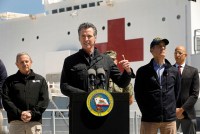
Newsom’s Ambitious Health Care Agenda Crumbles In A ‘Radically Changed’ World
California Gov. Gavin Newsom charged into 2020 with ambitious — and expensive — proposals to increase health insurance coverage, reduce homelessness and tackle drug prices. Then came COVID-19.

What’s Missing In The Coronavirus Response
Public health researchers offered a range of ideas — from high-tech to tried-and-true public health interventions ― that could aid the U.S. response to COVID-19.