Latest Morning Briefing Stories
Federal Aid for Lead Cleanup Is Receding. That’s a Problem for Cash-Strapped Cities.
Congress and the Trump administration are rolling back some lead remediation resources. Case studies of two cities and a state that faced lead contamination problems could give cash-strapped cities ideas of how to address such pollution themselves.

ICE, ALS, Addiction Medicine, and Robotic Ultrasounds: Journalists Sound Off on All That and More
KFF Health News journalists made the rounds on national and local media recently to discuss topical stories. Here’s a collection of their appearances.
What the Health? From KFF Health News: What About the State of Health?
Health care got barely a mention in President Trump’s State of the Union address. Ahead of the midterms, the Trump administration has presented few concrete plans to address what Americans say is the biggest problem with health care: its skyrocketing costs. Meanwhile, Trump’s pick for surgeon general, Casey Means, got her long-delayed nomination hearing in the Senate, where she faced skeptical questions from Democrats and Republicans alike. Alice Miranda Ollstein of Politico, Sheryl Gay Stolberg of The New York Times, and Lauren Weber of The Washington Post join KFF Health News’ Julie Rovner to discuss those stories and more.

En batalla por fondos, demócratas denuncian falta de atención médica para detenidos por el ICE
El esfuerzo de deportación masiva del presidente Donald Trump ha llevado a un número récord de inmigrantes detenidos en centros federales, cárceles locales y prisiones privadas. La situación pone en riesgo la salud de los detenidos.
Hospitals Fighting Measles Confront a Challenge: Few Doctors Have Seen It Before
As the number of cases grows to about 1,000 in the Carolinas, health care workers who’ve never seen the vaccine-preventable disease can get caught by surprise.

New Orleans Brings Back the House Call, Sending Nurses To Visit Newborns and Moms
Louisiana is one of the worst-performing states when it comes to health outcomes of mothers and infants. New Orleans is trying to catch health issues early and get families off to an easier start by adding health visits during the crucial first months of life.
What the Health? From KFF Health News: Turnarounds and Shake-Ups
The twists and turns continue at the nation’s health agency, where this week’s announcements included notice that the FDA will review Moderna’s new flu vaccine after all and that a handful of top agency officials are getting new jobs. Those developments and others can be traced to a White House looking to shake things up before the midterms — and win over voters on health care. Tami Luhby of CNN, Shefali Luthra of The 19th, and Lauren Weber of The Washington Post join KFF Health News’ Mary Agnes Carey to discuss these stories and more.
Journalists Unpack Impact of ICE Arrests on Families and Caffeine’s Effect on Dementia Risk
KFF Health News journalists made the rounds on national or local media recently to discuss topical stories. Here’s a collection of their appearances.
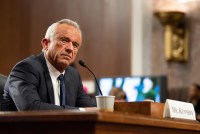
RFK Jr. Made Promises in Order To Become Health Secretary. He’s Broken Many of Them.
Before being confirmed to lead the Department of Health and Human Services, Robert F. Kennedy Jr. told U.S. senators he would not cut funding for vaccine research or change the nation’s official vaccine recommendations. He did both.
What the Health? From KFF Health News: New Flu Vax? FDA Says No Thanks
It’s been a busy week at the FDA, with a political appointee overruling agency scientists to reject an application for a new flu vaccine. Meanwhile, anti-abortion Republicans on Capitol Hill complain the agency is dragging its feet on reviewing the abortion pill mifepristone. Jackie Fortiér of KFF Health News, Lizzy Lawrence of Stat, and Alice Miranda Ollstein of Politico join KFF Health News’ Julie Rovner to discuss these stories and more.

Louisville Found PFAS in Drinking Water. The Trump Administration Wouldn’t Require Any Action.
After detecting a sudden spike in PFAS in its drinking water, the city traced it upstream along the Ohio River to a factory in West Virginia. But the EPA has relaxed Biden-era plans to regulate PFAS levels. So what happens next?

Trabajadores de salud pública renuncian antes de ir a Guantánamo
Oficiales del Servicio de Salud Pública que trabajaron en Guantánamo el año pasado describieron las condiciones en las que se encontraban los detenidos inmigrantes.

US Cancer Institute Studying Ivermectin’s ‘Ability To Kill Cancer Cells’
At a January event organized by allies of health secretary Robert F. Kennedy Jr., National Cancer Institute Director Anthony Letai said results may be released “in a few months.” Ivermectin, used to deworm horses and other animals, has become a symbol of resistance against the medical establishment among supporters of Kennedy’s “Make America Healthy Again” agenda and many conservatives.

This Ballad Hospital, Flooded by Hurricane Helene, Will Be Rebuilt for $44M in a Flood Plain
Ballad Health, the nation’s largest state-sanctioned hospital monopoly, plans to rebuild Unicoi County Hospital on land that two climate modeling companies say is at risk of flooding.
Public Health Workers Are Quitting Over Assignments to Guantánamo
U.S. Public Health Service doctors and nurses are being deployed to Guantánamo and other detention centers as President Donald Trump escalates mass arrests in his campaign to curb immigration. Some have resigned in protest. Others offer a rare look into bleak conditions.
Journalists Describe Drivers of High Health Costs and Spell Out the Science of Protein
KFF Health News journalists made the rounds on national and local media recently to discuss topical stories. Here’s a collection of their appearances.
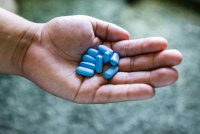
Effective but Underprescribed: HIV Prevention Meds Aren’t Reaching Enough People
PrEP has been available for more than a decade, but billing mistakes, lack of awareness, and lingering stigma keep many people from getting the lifesaving HIV prevention medication.
What the Health? From KFF Health News: HHS Gets Funding, But How Will Trump Spend It?
Congress has passed — and President Trump has signed — the annual spending bill for the Department of Health and Human Services. But it’s unclear whether the administration will spend the money as Congress directed. Anna Edney of Bloomberg News, Joanne Kenen of the Johns Hopkins Bloomberg School of Public Health and Politico Magazine, and Sandhya Raman of CQ Roll Call join KFF Health News’ Julie Rovner to discuss that story and more. Also this week, Rovner interviews KFF Health News’ Renuka Rayasam about a new reporting project, “Priced Out.”

Poison at Play: Unsafe Levels of Lead Found in Half of New Orleans Playgrounds
Verite News’ reporters tested soil in more than 80 playgrounds for lead contamination. Even in trace amounts, lead exposure in children can result in lower IQs, learning challenges, and behavioral issues.

Listen: Many Tents Are Gone, but Washington’s Homeless — And Their Health Problems — Aren’t
Sweeps of encampments scatter homeless people, as medications are tossed and street medicine providers scramble to reconnect with their patients. KFF Health News senior correspondent Angela Hart discusses the aftermath on the Jan. 28 edition of WAMU’s “Health Hub.”