Kennedy, Balancing MAHA and White House, Says He Won’t Run for President in 2028
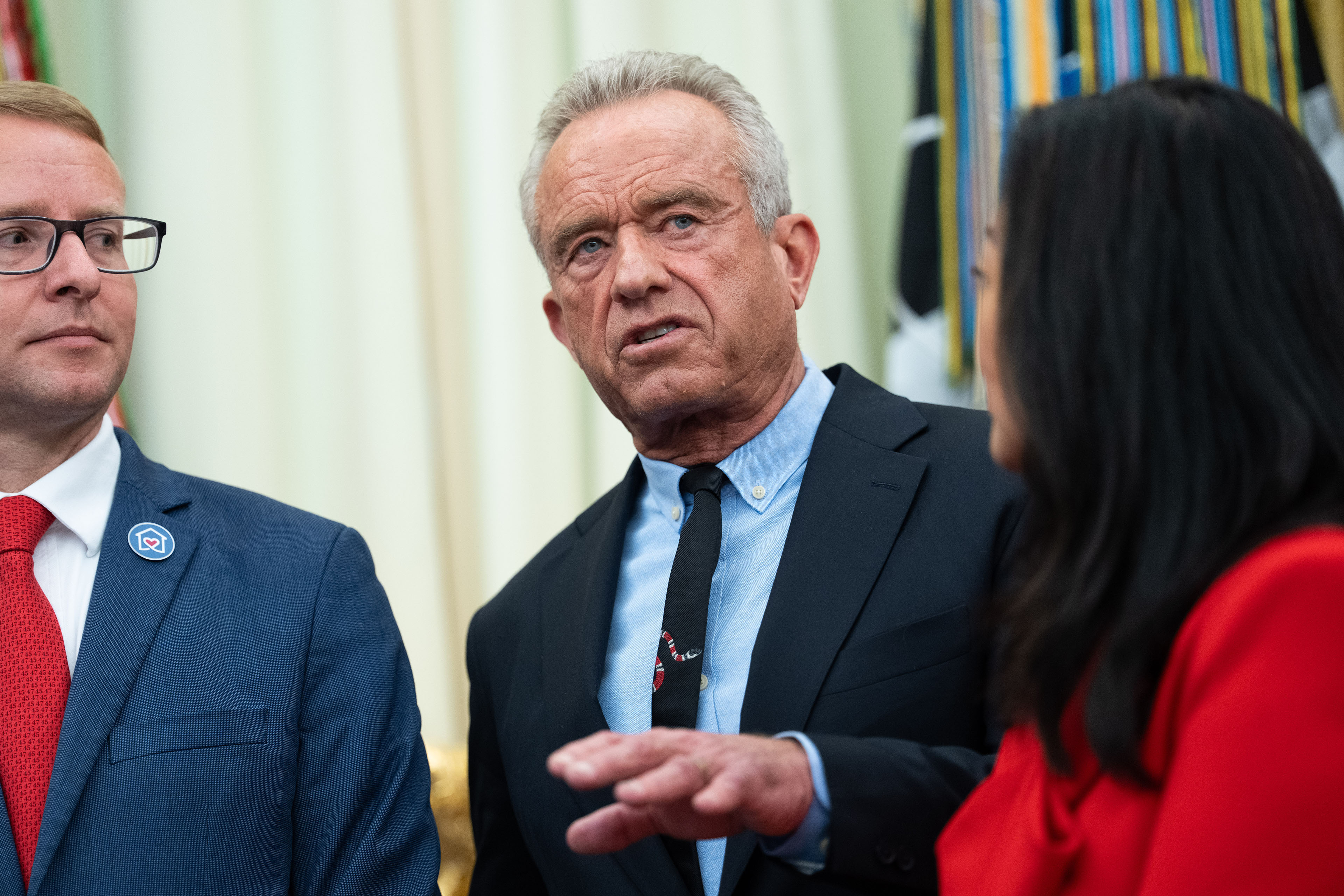
Health and Human Services Secretary Robert F. Kennedy Jr. speaks during a maternal healthcare event hosted by President Donald Trump on May 11. (Aaron Schwartz/Sipa/Bloomberg via Getty Images)
Health and Human Services Secretary Robert F. Kennedy Jr. is caught between his Make America Healthy Again supporters who want him to do more to advance their priorities, including curtailing vaccines, and a White House trying to combat President Donald Trump’s unpopularity.
Protesters’ chants could be heard from inside the Cleveland City Club, where Kennedy was speaking to a bipartisan group of citizens as part of his recent tour of northern Ohio. His calls for parents to have more “choice” on vaccinating their children was met with applause from half of the room. The other half released exasperated sighs and gasps.
His travel schedule is about to get busier: Kennedy is expected to stump for GOP lawmakers, traveling to states with competitive races in the upcoming midterm elections.
The goal of Kennedy’s campaign appearances is to shore up support for Republican candidates. But his targeted presence underscores the increasingly intense push and pull Kennedy faces as he works to maintain enduring political viability with GOP voters — especially MAHA supporters.
His challenge is complicated by a widening schism between the White House and Kennedy’s anti-vaccine crusade. Some MAHA adherents feel betrayed by the Trump administration, which they say is thwarting the movement’s agenda by not doing more to limit pesticides, halt access to covid shots, or investigate conspiracy theories about airplane contrails poisoning the skies.
Meanwhile, some in the MAHA camp hope Kennedy will announce his own run for the White House in 2028.
But Kennedy says he has no such aspirations. Asked by KFF Health News on May 7 whether he sees a path to run for the presidency again as a Republican, he replied firmly: “No, I’m not going to run.”
Changing his position about running would put Kennedy on a collision course with President Donald Trump, who’s reportedly weighing Secretary of State Marco Rubio and Vice President JD Vance as possible successors. (Trump, too, has mused about running again in 2028, though the 22nd Amendment would prohibit it.) A Kennedy candidacy could also sap much of the Trump administration’s work on other MAHA causes, because the secretary would likely leave his role at the Department of Health and Human Services.
“If he isn’t secretary, then MAHA’s influence will severely diminish,” said David Mansdoerfer, who served as deputy assistant secretary for health at HHS in the first Trump administration.
“Running would be perfectly logical for Bobby,” said Christopher Bosso, a public policy and political science professor at Northeastern University. “Kennedy is being a good soldier, but to what extent? That is going to be a question.”

‘A Grave Misstep’
Recent Trump administration actions have riled up MAHA supporters. The president in April nominated Erica Schwartz, a doctor and vaccine supporter, to lead the Centers for Disease Control and Prevention. Kennedy fired Susan Monarez, the agency’s previous director; she testified she was ousted for not preapproving vaccine recommendations.
Schwartz’s nomination and White House efforts to shift Kennedy’s focus away from vaccines stand in stark contrast with 2024, when Trump pledged to let Kennedy “go wild” on health.
In an interview, Kennedy said “I think I have” gone wild on health. He shot down claims that the White House has limited his work.
“President Trump has let me do more than any HHS secretary in history,” Kennedy said.
Kennedy has said he supports Schwartz, though he told lawmakers last month that he did not discuss her nomination with Trump. MAHA adherents have criticized her backing of covid vaccines, holding it up as evidence that the White House is restricting the health secretary.
“Trump’s pick to head the CDC, Erica Schwartz, would likely be a disaster,” Aaron Siri, a lawyer and Kennedy ally, said on X, citing her work supporting the covid vaccine rollout.
Trump also withdrew the nomination of wellness influencer Casey Means, another Kennedy ally, for U.S. surgeon general. In May, the president nominated Nicole Saphier, a radiologist and former Fox News contributor. MAHA adherents have panned the selection, which reflects a more mainstream and traditional medical approach to the position. Means had faced pushback from some Republican senators for questioning contraception methods and refusing to reject the debunked link between vaccines and autism.
“DOGE the Surgeon General!!! We want medical freedom!!!! If not Casey – we take no one!” Vani Hari, a MAHA influencer, said May 1 on X.
Taken together, these actions threaten to weaken MAHA support for GOP candidates. But many Republicans in competitive races are already distancing themselves from the grassroots, vaccine-skeptical “medical freedom” movement led by Kennedy.
Many MAHA supporters also feel let down by Trump administration directives that rolled back environmental regulations and promoted pesticides. Some now see a Kennedy presidency as critical to attaining their policy goals.
Stephanie Weidle “100%” wants to see Kennedy run again. The 34-year-old Washington, D.C., resident was outside the Supreme Court last month during a rally to oppose protections for the weed-killing chemical glyphosate.
A reliable Republican voter, Weidle described the administration’s actions as disappointing. She wants to see Kennedy go further on examining the childhood vaccine schedule and limiting chemical use on crops.
“His hands have been tied,” Weidle said of Kennedy. She believes the White House has ordered him to back down from those controversial issues. “Republicans have made a grave misstep in not leading with MAHA.”
Vaccines Are a Flash Point
In the midst of these dynamics, Kennedy is attempting to thread the needle between the White House, which wants him to back away from attacking vaccines, and MAHA supporters who want him to do more. He has sought to appease both sides, praising Saphier as the surgeon general pick and describing her on X as a “long-time warrior for the MAHA movement.”
He’s also tempered his public focus on vaccines. His podcast, which he said would “confront the lies” that lead to illness, has veered away from the topic and centered instead on food and nutrition.
During his recent congressional hearings, he also focused on initiatives that poll well with voters. Appearing before the House Ways and Means Committee, Kennedy offered an opening statement focused on healthcare affordability and drug prices, issues he had shied away from during his first few months on the job.
While he mentioned his redesign of nutritional guidelines and pressing industry to cease its use of certain food dyes, he avoided more controversial topics that underscored his first few months in office, including his attempt to upend the childhood vaccine schedule and efforts to explore causes of autism.
Despite his pivot to more popular subjects, Kennedy’s draw weakens beyond MAHA circles. A March straw poll of more than 1,600 attendees at the annual Conservative Political Action Conference found nearly zero support for him as a presidential candidate when participants were asked who they would vote for if the election were held today.
“He has a constituency that is very much attached to MAHA that may not vote in the Republican primaries or in a general election,” said Robert Blendon, professor emeritus of health policy and political analysis at Harvard University.
Kennedy ran for president in the 2024 race as a Democrat, then as an independent, before halting his campaign in August 2024 and throwing his support behind Trump.
Some of the president’s advisers credit Kennedy’s MAHA voters with tipping the scales just enough to help Trump secure his 2024 election win. About a third of U.S. adults now identify as MAHA supporters, according to a March poll by Politico, and support is highest among Republicans who also back Trump’s Make America Great Again political movement.
Vaccine policy is galvanizing voters on both sides. Eighty-one percent of voters said vaccine policy, including decisions about what vaccines are recommended for children, will have an impact on their decision to vote in the 2026 midterm elections, according to a KFF poll conducted in April. Voters said they trust Democrats more than Republicans on vaccine policy and other health issues, according to the poll.
But healthcare — especially its costs — looms larger as an issue. Sixty-four percent of voters said that they are very or somewhat worried about healthcare, including the cost of health insurance and out-of-pocket costs for things like office visits and prescription drugs, and 88% said such costs will have an impact on their vote.
Many of the MAHA faithful question whether their political muscle really matters.
Republicans seem less convinced the constituency will make or break the midterm election results.
Republicans in Congress and the administration “have decided not to run on MAHA for the midterms,” Robert Malone, a scientist and Kennedy ally who stepped away in March from his position on the federal Advisory Committee on Immunization Practices, said April 16 on X.