Two things are true right now in America: support for “Medicare for All” is at its highest in a decade, and voters aren’t exactly sure what it is.
It’s no coincidence that Medicare for All is having a moment when fewer than half of Americans say they can afford their healthcare. And on the campaign trail, Medicare for All has become a progressive shorthand for radical, systemic change.
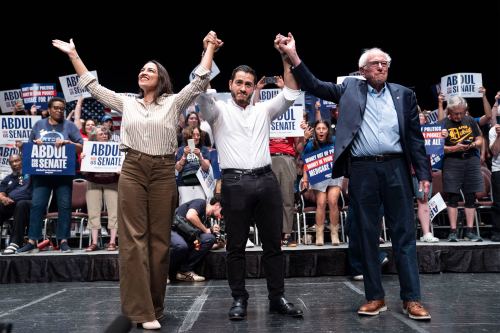
Nowhere is that clearer than in Michigan, a battleground state where Democratic U.S. Senate candidate Abdul El-Sayed is drawing thousands to town halls, chanting a campaign slogan they know by heart: “Money out of politics. Money in your pocket. Medicare for All.”
Yet the same people who’ll tell you they support Medicare for All might not know how it would work, what it would do, or even what it’s called (“Medicaid for All” is a frequently heard misnomer here, including when a Republican state lawmaker criticized it at Republican U.S. Senate candidate Mike Rogers’ healthcare press conference.)

Email Sign-Up
Subscribe to KFF Health News' free weekly newsletter, "The Week in Brief."
What they do know is their premiums keep rising, their deductibles could wipe out their savings, and they must juggle a seemingly endless barrage of medical bills that always seem to gobble up whatever is left after groceries and gas.
“Too many people don’t have health insurance, too many people who do have insurance can’t afford medical care, and many people are terrified about the costs of being sick,” said Jonathan Oberlander, a professor at the University of North Carolina-Chapel Hill who specializes in the politics of healthcare reform.
That makes Medicare for All “an important symbol” in this election, he said. In just three words, it allows voters to reject incrementalism, voice their anger toward the system, and demand that healthcare be treated as a fundamental right, not an increasingly unobtainable luxury.
Cindy Lou Coolich of Pinckney, Michigan, attended El-Sayed’s town hall in Lansing last month, dressed in a campaign T-shirt and cowboy hat. For years, she worked for a company that helped uninsured people enroll in Medicaid. Some of those patients had million-dollar medical bills, she said. Others would try to navigate the red tape, only to die before the state would deem them qualified for coverage.
Then she had her own healthcare crisis, when a bout of sepsis left her disabled and unable to work. Suddenly, she was the one enrolling in Medicaid and living off $900 a month in Social Security. “I lost everything, except my car,” she said.
The saving grace, oddly, was the death of her ex-husband. Because they’d been married for more than 10 years, she could receive his Social Security benefits. But to her, it hardly seemed like the mark of a functioning healthcare system that someone had to die for things to get better.
The idea of scrapping the U.S. health insurance system for a massive expansion of government-funded healthcare isn’t new. But voters hit by ballooning private health insurance costs are rallying behind midterm candidates calling for universal coverage.