Efforts To End School Vaccine Mandates Hit a Wall in Florida

(E+/Getty Images)
Every state, along with Washington, D.C., requires children to obtain certain vaccinations before they can attend school or childcare. These mandates date back decades, and many public health experts consider them a foundational defense against infectious disease.
Since the summer of 2025, Florida leaders have aimed to make the state the first to drop some of those vaccine mandates. The anti-vaccine rhetoric has often been positioned as a push for “medical freedom.” Related efforts to revise laws and regulations rumbled along at the state health department and in the legislature for months.
But by the end of April, the fight seemed to have stalled out.
In the opening minutes of a special session on April 28, the Republican speaker of the Florida House, Daniel Perez, refused to bring the vaccine issue to the floor.
“There is some concern here, on my behalf, about children being in school without measles, mumps, polio, and chickenpox vaccines that have been working for decades,” Perez told reporters afterward.
For now, at least, the push to end childhood vaccine mandates has failed in Florida, and that outcome could offer insights into such efforts’ chances in other states. An Associated Press analysis found that at least 350 anti-vaccine bills were introduced in state legislatures last year. Many focused on relaxing requirements for vaccines in schools.
Ladapo: Mandates Are Bodily ‘Slavery’
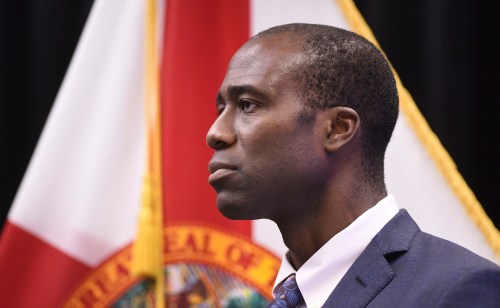
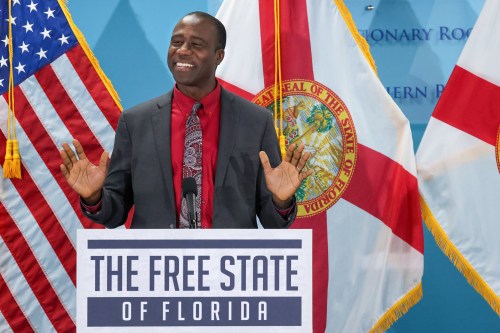
Last September, Gov. Ron DeSantis and Florida Surgeon General Joseph Ladapo set the stage for the anti-vaccine campaign. They held a news conference at a private Christian school east of Tampa, where Ladapo said the state would work to end all vaccine mandates in Florida law.
“Every last one of them is wrong and drips with disdain and slavery,” he said.
“Who am I, as a government or anyone else,” Ladapo said, “or who am I as a man standing here now, to tell you what you should put in your body?”
Political analysts say that the prospects for efforts to cut back on vaccine mandates are closely tied to the political prospects of Republicans trying to maintain their majorities at the state and federal levels. DeSantis is term-limited, and his governorship ends in January. And the congressional midterms are in November.
“For Republicans, they’re a little bit leery,” said Aubrey Jewett, an associate professor of political science at the University of Central Florida. “They know we’re in an election cycle. They know political history. And it’s pretty clear that the president’s party tends to lose seats in the midterm election.”
Although hundreds of anti-vaccine bills have been introduced in state legislatures, the noisy rhetoric and splashy headlines don’t guarantee passage, said Kelly Whitener, an associate professor of health policy at Georgetown University.
In many states, including Florida, “there’s a disconnect between what we hear a lot from a potentially vocal minority about how they feel about vaccines compared to where the majority of people really are,” Whitener said.
“For most people,” she said, ”they still support the idea of near-universal vaccination, still understand the importance of vaccinating children to protect people who can’t be vaccinated.”
A national poll last year by KFF and The Washington Post showed 81% of parents supported school vaccine requirements.
“They support these vaccines,” said Jen Kates, a senior vice president at KFF, a health information nonprofit that includes KFF Health News. “They support protecting their kids through these mandates. And that includes Florida parents.”

Unwinding Mandates by Law, and by Regulation
To undo some of the vaccine mandates, Florida’s legislature would have to pass new bills. Others could be changed by a rulemaking process at the state Department of Health, including for chickenpox, hepatitis B, pneumococcal conjugate, and Haemophilus influenzae type B.
At a Dec. 12 forum in Panama City hosted by the health department, public comment went on for hours, with those who wanted to keep the mandates slightly outnumbering those who opposed them.
“This is about freedom,” said one speaker, Larry Downs Jr. “The default setting should be freedom, not these corporate chemical vaccine injections.”
Florida schoolteacher Marion Fesmire has worked overseas. She defended vaccine requirements in part because of some of the suffering she has seen.
“I’ve seen kids with polio. I’ve seen blind kids. I’ve seen kids die before they’re even 10 years old. It’s heartbreaking,” Fesmire said.
The health department hasn’t held any more public forums on vaccines since then.
Nor has the department filed the paperwork needed to change the vaccination rules, including a statement of regulatory costs. In that, the department must estimate whether changing the rules could affect personal income, the number of visitors to the state, or the size of the Florida workforce.
In an April 13 email, the health department said that it is “currently in the rulemaking process” and that any updates would be posted in the Florida Administrative Registrar.
Pushing for a New Exemption
During the winter legislative session, a vaccine-related bill, SB 1756, didn’t include removing mandates but did feature a new kind of exemption. In addition to a religious or medical exemption, a parent could exempt a child for reasons of personal conscience. This type of exemption is available in 17 states.
Democrats, the minority in the Florida Legislature, came out against it.
“It’s currently very easy to opt out for religious reasons from school immunizations,” state Sen. Carlos Guillermo Smith (D) said while speaking from the chamber floor. “Why is this bill necessary? Given that context, is your bill just about giving people more options to ignore school immunizations, or is it intended to solve a public health problem?”
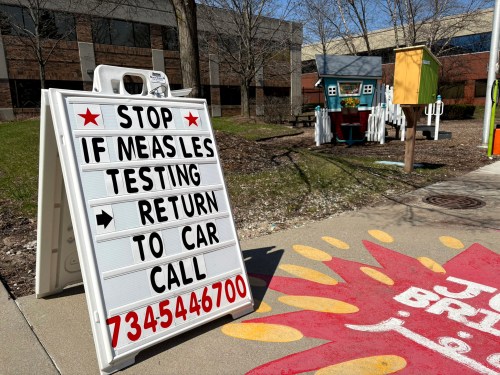
A few Republicans also opposed the bill. State Sen. Gayle Harrell (R) brought up the measles outbreak. Florida is the state with the fourth-highest number of measles cases this year, with 155 as of June 6.
“I truly believe that this is a dangerous bill, and I cannot vote for it,” Harrell said.
The bill also included a permanent ban on mandates for any mRNA-based vaccines and would have allowed nonprescription sales of ivermectin. That anti-parasite medication rose to popularity as an alternative treatment for covid, although the Food and Drug Administration determined that the available clinical trial data does not demonstrate effectiveness against covid in humans.
Florida’s previous surgeon general, Scott Rivkees, condemned the ivermectin proposal, calling it “the equivalent of walking into a pharmacy and requesting amoxicillin for a self-diagnosed infection.”
In the end, the “medical freedom” measure died when the House version of the bill failed to make it to committee.
Yet, people on both sides say the Florida fight is far from over, especially given the lingering mistrust of the medical establishment after the covid pandemic.
“There are many more people now who have skepticism about the wisdom of public health policy and law,” said Barbara Loe Fisher, an anti-vaccine activist who has been working to end mandates since the early 1980s.
“I don’t think that that’s going to disappear,” she said. “I think it’s going to grow.”
This article is from a partnership that includes WUSF, NPR, and KFF Health News.