Montana Moves Ahead With Doula Pay but Warns Medicaid Cuts Still May Come
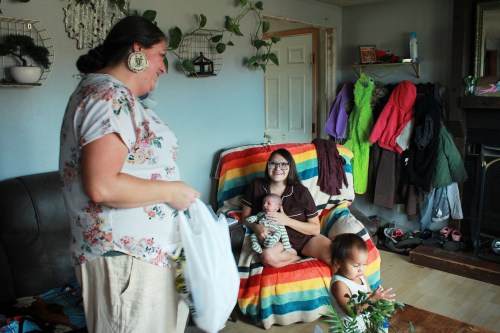
Misty Pipe, a doula in Lame Deer, Montana, on the Northern Cheyenne Indian Reservation, visits with a family she had recently supported through pregnancy. Lame Deer is about 100 miles from the closest hospital that delivers babies, so Pipe offers free doula care outside of her post office job. “Women need this help,” Pipe says. (Katheryn Houghton/KFF Health News)
Montana officials said they are moving forward with plans to allow Medicaid to pay doulas, reversing a previous statement that budget problems had prompted them to pause the effort to reimburse the birth workers.
But officials warned that all optional Medicaid services are still under review as the state health department looks for cuts to offset a shortfall driven by higher-than-expected Medicaid costs.
Jon Ebelt, a spokesperson with the Montana Department of Public Health and Human Services, said the agency is preparing a request to the federal government to add doula care to the state’s Medicaid program. It would cost the state about $118,000 in its first year to provide doula Medicaid reimbursements, according to state estimates.
His April 15 comments came three weeks after department officials told KFF Health News that the state budget deficit had put those plans on hold. Ebelt denied that a final decision had been made in March to scrap the doula Medicaid payments, which state lawmakers approved in a bill last year. The coverage is “now proceeding as planned,” he said.
“At the time of your initial inquiry, we were still in the process of analyzing the appropriation,” Ebelt said.
Federal health officials must approve any amendments to the state’s Medicaid program before payments can begin. At least 25 other states reimburse doulas through Medicaid.
Doulas are trained, nonmedical workers who support people through pregnancy and after they give birth. The care they provide is linked to reductions in health complications, which has prompted more states to cover doula services in recent years.
Montana lawmakers who supported expanding Medicaid to cover doula care in 2025 cited scarce maternity services, especially in rural and Indigenous communities. But this year, the state has a Medicaid budget deficit of more than $177 million and is expecting a similar shortfall next year. Plus, federal policy changes slated to take effect later this year are expected to increase costs.
“ There’s a need and a desire for doula services, but a lot of people can’t afford it,” said Sheri Walker, a Helena-based doula and president of the Montana Doula Collaborative. “So that means many of us have other jobs that we have to juggle.”
Walker is a part-time labor and delivery nurse outside of her doula work.
On March 25, health department spokesperson Holly Matkin said in an email to KFF Health News that the agency “will not be moving forward with the implementation of doula services in the Montana Medicaid benefit package at this time.” She had added that it was unclear whether state law gives the department the authority to authorize coverage during the budget shortfall.
State Sen. Cora Neumann, a Democrat who sponsored last year’s bipartisan doula reimbursement bill, said she didn’t know about the department’s plans until she saw KFF Health News’ reporting. Neumann said she and groups that had backed the legislation began calling health officials, making the case for doula services as a low-cost way to provide critical care.
After about a week, Neumann said, state officials told her the agency was moving ahead with doula services after all.
“They were on the chopping block,” Neumann said. “This is a story of how important it is for all Montanans to pay attention and stay connected to what’s happening.”

Ebelt did not clarify what led the department to change its position. However, he warned that optional Medicaid services, such as doula services, may still be cut.
“All optional services, including this service, are being reviewed,” Ebelt said, referring to doula care. He did not respond to a follow-up query as to whether the department might still decide to postpone the program following federal approval.
Optional services are types of care that states choose to cover through their Medicaid programs but aren’t required by federal law. That can include covering eyeglasses, prescription drugs, and prosthetics, and more specialized care such as physical therapy, or inpatient psychiatric services for people under 21.
Those services may not sound optional, said Liz Williams, who studies Medicaid financing at KFF, a health information nonprofit that includes KFF Health News. But she said they’re one of the few avenues states have to make adjustments when budgets get tight.
Congressional Republicans’ One Big Beautiful Bill Act, the spending measure President Donald Trump signed into law last July, is expected to put more states in a budget crunch as its provisions start to take effect by the end of the year. The federal government has estimated that the law will reduce federal Medicaid spending by nearly $1 trillion over 10 years. The law also left states with a higher share of the costs to provide food assistance.
Williams said many states expanded services in recent years by boosting optional Medicaid benefits and provider pay.
“We could see them walk those back,” Williams said.
Montana’s financial problems preceded federal changes. Last year, state lawmakers cut some of the health department’s funding and underestimated Medicaid use. The state also overestimated what the federal government would pay toward Montana’s Medicaid costs.
Health officials must outline a plan to cut costs before the state’s 2027 budget year begins on July 1. Simultaneously, the agency is trying to hire more staffers to begin vetting whether Medicaid enrollees meet or are exempt from new work requirements that also go in place July 1. The new rules, mandated through long-delayed state legislation and the federal spending law, will have a three-month grace period.
Stephanie Morton, executive director of Healthy Mothers, Healthy Babies-The Montana Coalition, said she’s grateful the state is back on track to pay for doula services through Medicaid. But she said she’s worried about potential health care cuts to come.
“We know that doulas are a critical piece of that infrastructure, but standing alone and losing other sources of care really isn’t optimal,” Morton said. “These are not robust systems as it stands.”