She Struggled To Get a Lifesaving Drug Even After Insurers Vowed To Help
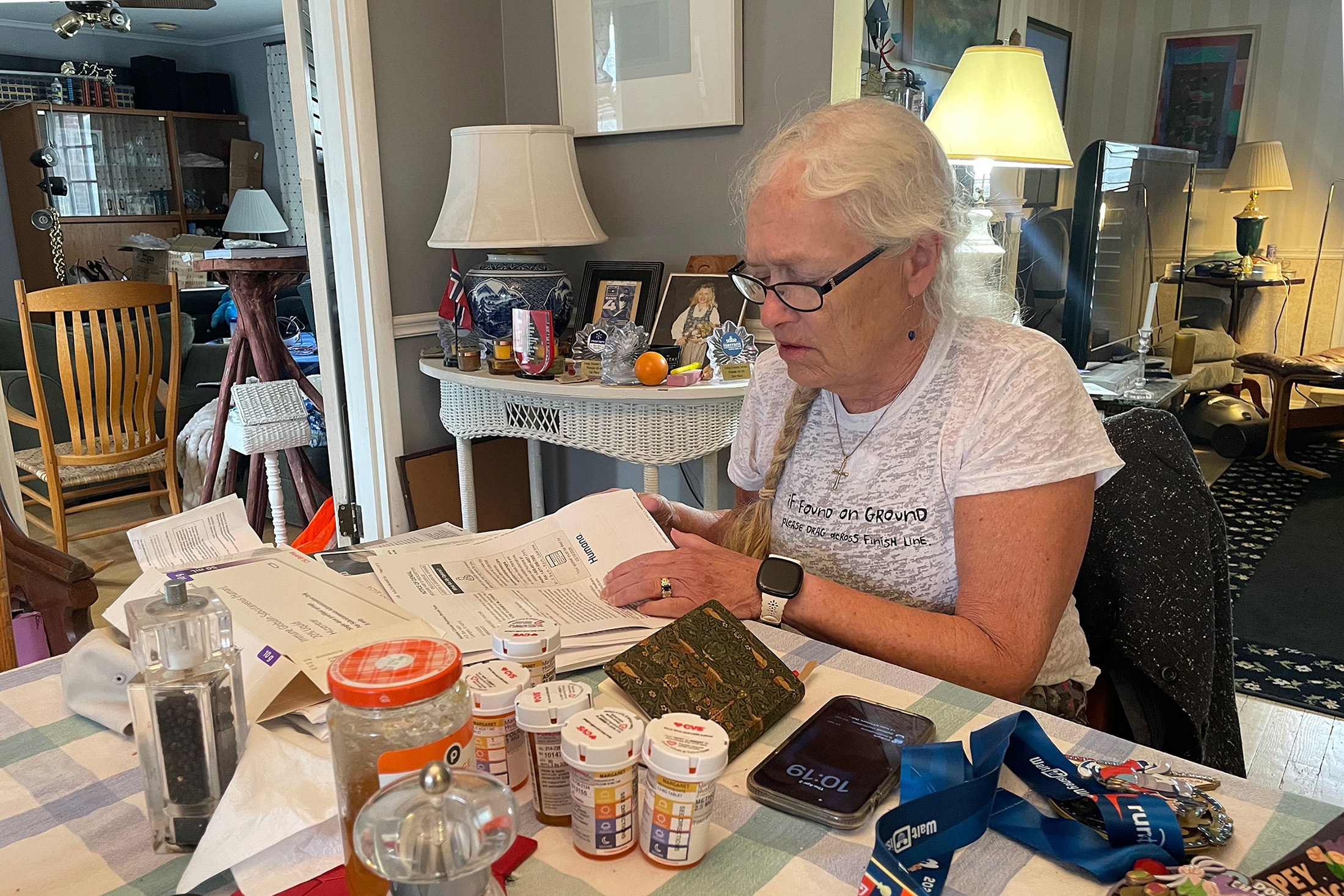
Weeks after Margaret Hvatum’s Humana Medicare Advantage plan denied coverage of a medicine she needs for a chronic condition, she was admitted to a hospital. Here Hvatum sits at her dining room table in her suburban St. Louis home sorting through letters from the insurer. (Samantha Liss/KFF Health News)
LADUE, Mo. — Over four consecutive days in January, Margaret Hvatum ran a 5K, a 10K, a half-marathon, and a full marathon. The 70-year-old covered a combined distance that’s nearly equivalent to running the length of Manhattan four times.
By the end of the month, she was in a hospital bed.
Hvatum, a part-time computer science professor, has a weakened immune system due to a rare condition known as primary immunodeficiency, which makes it difficult for her body to fight infections. Prior to her 2005 diagnosis, she had four bouts of shingles, a painful rash caused by a virus.
For more than a decade she relied on an expensive medicine to treat her chronic condition — and relied on her insurance to pay for it.
Then the denial letters came.
The Medical Service
To give her weakened immune system a boost, she relies on Hizentra, which is made up of antibodies collected from donated blood plasma.
At her home, near St. Louis, Hvatum can administer the complex medicine herself. She uses a large syringe to draw the medicine from a vial and loads the syringe into a plastic apparatus that looks like a toy Nerf gun. She cranks a blue plastic dial that triggers a steady drip of the medicine, and it snakes through plastic tubing until it enters her leg through a needle.
The Bill
$8,141.94: The full charges for a 28-day supply of Hizentra without insurance coverage.
After her Medicare Advantage plan through Humana denied payment for the drug in January, she missed several weekly doses.
The Billing Problem: Prior Authorization
Hvatum got tangled up in the controversial process known as prior authorization, which often requires patients or their medical team to get an insurance company’s approval before obtaining medicines or treatment.
At the start of the year, after Hvatum switched Medicare Advantage plans, she received a letter saying that Humana, her new carrier, had denied her “prior authorization prescription request” for Hizentra. The authorization from her previous insurer didn’t carry over.
Without the medicine, Hvatum developed a urinary tract infection that sent her to the emergency room on Jan. 30. Though it is a common infection, her doctor advised her to go there because people with her condition can get sick and deteriorate quickly, she said.
That ER visit turned into an overnight hospital stay. That turned into hospital charges of more than $18,000, and again her insurance denied payment, saying this time that she wasn’t sick enough to require hospital care.
Hvatum’s experience with prior authorization is not unique.
Medicare Advantage plans reviewed nearly 53 million prior authorization requests in 2024, according to KFF. That’s equivalent to nearly two reviews for every person enrolled in the program.
It’s common for Medicare Advantage plans to deny payment for care — which helps them make a profit, said Carrie Graham, director of the Medicare Policy Initiative at Georgetown University’s Center on Health Insurance Reforms.
The government pays a monthly sum to Medicare Advantage insurers to cover care for each member. “They make a profit if the care that person receives in that year is less than the amount they receive,” Graham said.
More than half of eligible Medicare beneficiaries choose Medicare Advantage insurance coverage. In 2026, roughly 35 million selected one of these private policies offered by insurance companies.
Humana is a dominant player in the space. Nearly half of all Medicare Advantage enrollees nationwide are covered by UnitedHealth Group or Humana, according to KFF.
The killing of UnitedHealthcare CEO Brian Thompson prompted renewed scrutiny of prior authorization. Last summer, months after his death, the nation’s largest insurers, including Humana, signed a pledge that outlined a handful of commitments to ease the burden on patients.
For example, insurers vowed to reduce the number of services that would require prior authorization approval. They also promised to reduce delays by honoring existing prior authorizations for a 90-day period when patients switched plans.
That’s not what happened in Hvatum’s case.

Humana said this pledge to honor existing approvals comes with limitations. “These commitments are for medical services only and do not apply to prescription medications,” spokesperson Mark Taylor said.
Humana declined to comment on the specifics of Hvatum’s case, even though she agreed to waive her privacy rights, giving the insurer permission to comment.
While acknowledging that the prior authorization process can be deeply frustrating for patients, Humana said it “builds important checks and balances into the healthcare system by verifying that treatments and care delivery are in the best interest of patient safety and quality of care, while safeguarding taxpayer dollars.”
In July 2025, Humana said it would remove one-third of prior authorization requirements for outpatient services.
“We are committed to making the process faster and more seamless for patients and providers,” Humana said in a statement Taylor provided to KFF Health News.
The Resolution
Hvatum appealed, and Humana in late January reversed its initial payment denial for Hizentra, enabling her to afford her medicine again.
But the approval came with a catch: It expires at the end of the year, after which she would need to obtain approval all over again.
Hvatum has since switched to a different drug — and she might not stick around for any more medical-bill fights like this one. She and her husband are considering a move to Norway, a place with universal healthcare. He is a citizen there, which could give her a path to public health coverage.

The industry’s promises to change are too little, too late for Hvatum.
By her account, she has done her part. Running is her outlet, maybe an obsession, and it keeps her healthy. Scores of medals and trophies are tucked about her home. Some sit on a white wicker end table, next to family photos, candles, and framed St. Louis Cardinals memorabilia. Above a large bay window in the kitchen, medals hang from ribbons of all colors, made to look almost like custom window drapery.
“I have done everything I possibly can to be healthy,” Hvatum said, sitting at her dining room table in her running gear. Her printed T-shirt read, “If found on ground, please drag across the finish line.”
The Takeaway
Data shows patients should appeal prior authorizations, because those who do often get their denials reversed, Graham said. In fact, 81% of Medicare Advantage appeals were partially or fully overturned in 2024, according to KFF.
Relatively few people appeal, because “it’s an exhausting process,” Graham said. It puts the onus on patients — and doctors get frustrated, too.
It’s not just Medicare Advantage plans that subject enrollees to prior authorization approvals. It’s prevalent in other types of coverage, and it has prompted blowback from the public. Graham believes the public outcry instigated the industry’s pledge to change.
Hvatum is well versed in filing appeals. She submitted another appeal to Humana after the insurer denied payment for her January hospital stay. Humana again reversed its denial of payment in her case.
Hvatum blames Humana for her January trip to the hospital. Had Humana approved her Hizentra, she said, she could have avoided hospital care altogether.
In March, she had a stroke. Humana denied coverage of that hospital stay, too.
Humana determined that it was not reasonable for the physician who admitted Hvatum to think she would need to stay at least two nights, the threshold for approval. “You had a small stroke,” Humana’s denial letter stated.
Hvatum noted the letter was dated March 25, two days after she was hospitalized. Humana reversed its denial two weeks after Hvatum appealed.
“They love to send you the denials fast,” Hvatum said. “Approvals take longer.”
Bill of the Month is a crowdsourced investigation by KFF Health News and The Washington Post’s Well+Being that dissects and explains medical bills. Since 2018, this series has helped many patients and readers get their medical bills reduced, and it has been cited in statehouses, at the U.S. Capitol, and at the White House. Do you have a confusing or outrageous medical bill you want to share? Tell us about it!