100 Million People in America Are Saddled With Health Care Debt
The U.S. health system now produces debt on a mass scale, a new investigation shows. Patients face gut-wrenching sacrifices.
The independent source for health policy research, polling, and news.
More than 100 million people in America — a startling 41% of adults — are saddled with medical bills they cannot pay, according to a KFF Health News investigation with NPR and CBS News. The project exposed that medical debt — rather than fighting disease — is now a defining feature of the nation’s health care system.
The U.S. health system now produces debt on a mass scale, a new investigation shows. Patients face gut-wrenching sacrifices.
Medical breakthroughs mean cancer is less likely to kill, but survival can come at an extraordinary cost as patients drain savings, declare bankruptcy, or lose their homes, a KHN-NPR investigation finds.
Debt lawsuits — long a byproduct of America’s medical debt crisis — can ensnare not only patients but also those who help sick and older people be admitted to nursing homes, a KHN-NPR investigation finds.
Some hospitals notch big profits while patients are pushed into debt by skyrocketing medical prices and high deductibles, a KHN analysis finds.
Despite the end of Jim Crow segregation, its legacy lives on in medical debt that disproportionately burdens Black communities.
Hospitals strike deals with financing companies, generating profits for lenders, and more debt for patients.
Coal mining ended in Germany’s Saarland a decade ago, but the transition away from coal has been smoother than in West Virginia, which has more medical debt than any state in America.
An examination of billing policies and practices at more than 500 hospitals across the country shows widespread reliance on aggressive collection tactics.
As cities like Denver struggle to make homes more affordable, medical debt keeps housing out of reach for millions of Americans.
Loading…
Loading…
Have you been forced into debt because of a medical or dental bill? Have you had to make any changes in your life because of such debt? Have you been pursued by debt collectors for a medical bill? We want to hear about it.
KFF Health News’ yearlong investigation exposed a staggering failure of U.S. health care: It systematically pushes patients into debt.
“Diagnosis: Debt” revealed the scope and severity of this crisis as no one has before: A quarter of those with debt owe more than $5,000. And nearly as many with any amount of debt don’t expect to pay it off in their lifetimes. Black Americans are 50% as likely as whites to owe money for medical care. And 20% of U.S. hospitals will deny nonemergency care to patients with an outstanding bill.
The investigation unmasked the opaque world of medical billing and collections and a vast new industry that preys on patients. And it garnered prompt attention and action in Washington and beyond.
In intimate, multimedia stories, “Diagnosis: Debt” documented the suffering and sacrifices this burden forces on patients and their families. KFF Health News and our partners at NPR and CBS News profiled people driven from their homes, new parents who took on extra work, and retirees pushed to bankruptcy because of debt.
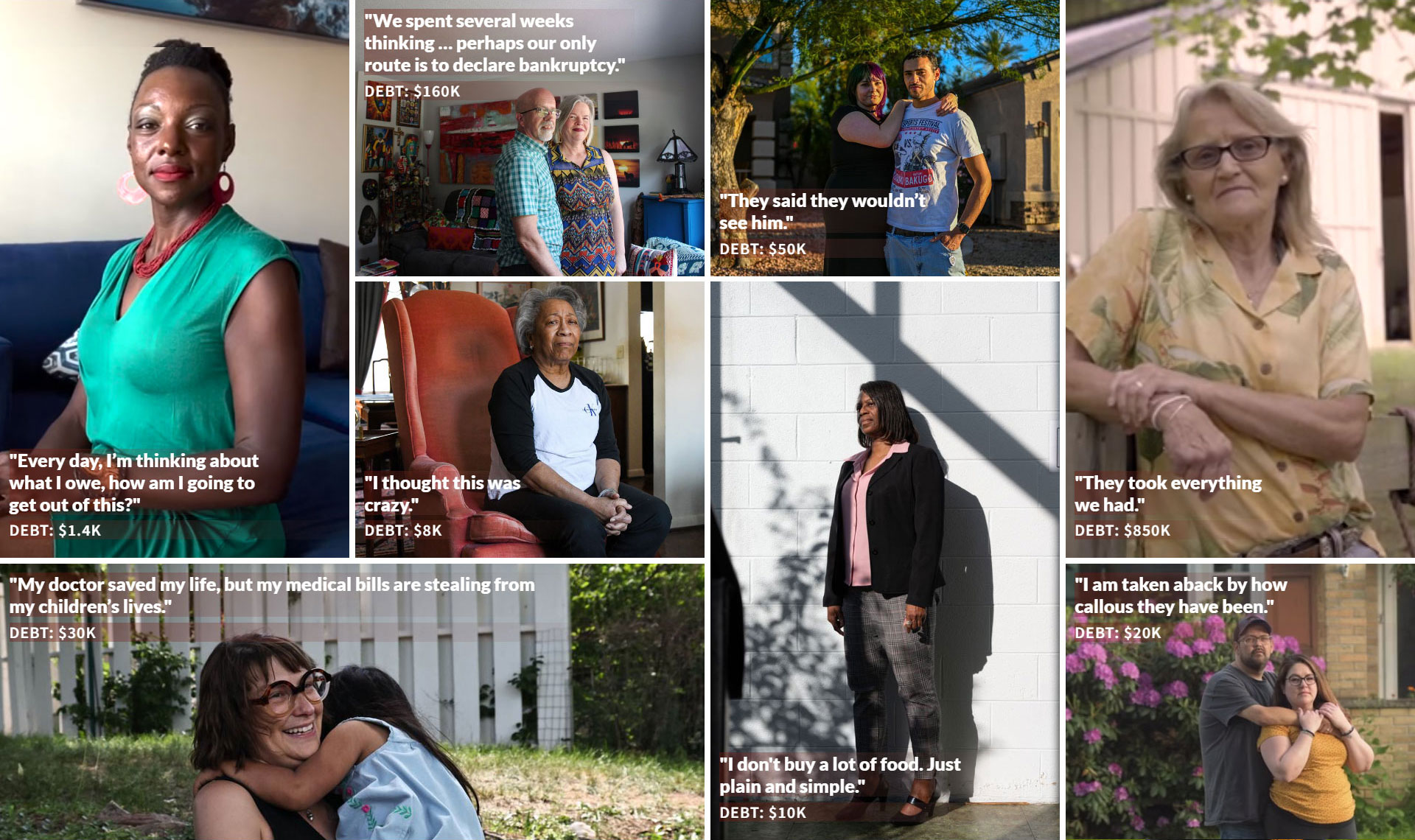
Some lost their homes. Some emptied their retirement accounts. Some struggled to feed and clothe their families. Medical debt now touches more than 100 million people in America, as the U.S. health care system pushes patients into debt on a mass scale. Debtors are from all walks of life and all corners of the country. Here are their stories ― how they got into debt, what they’ve given up for it, and how they’re living with the burden.
Loading…
“Diagnosis: Debt” is a reporting partnership between KFF Health News and NPR exploring the scale, impact, and causes of medical debt in America.
The series draws on original polling by KFF, court records, federal data on hospital finances, contracts obtained through public records requests, data on international health systems, and a yearlong investigation into the financial assistance and collection policies of more than 500 hospitals across the country.
Additional research was conducted by the Urban Institute, which analyzed credit bureau and other demographic data on poverty, race, and health status for KFF Health News to explore where medical debt is concentrated in the U.S. and what factors are associated with high debt levels.
The JPMorgan Chase Institute analyzed records from a sampling of Chase credit card holders to look at how customers’ balances may be affected by major medical expenses. And the CED Project, a Denver nonprofit, worked with KFF Health News on a survey of its clients to explore links between medical debt and housing instability.
KFF Health News journalists worked with KFF public opinion researchers to design and analyze the “KFF Health Care Debt Survey.” The survey was conducted Feb. 25 through March 20, 2022, online and via telephone, in English and Spanish, among a nationally representative sample of 2,375 U.S. adults, including 1,292 adults with current health care debt and 382 adults who had health care debt in the past five years. The margin of sampling error is plus or minus 3 percentage points for the full sample and 3 percentage points for those with current debt. For results based on subgroups, the margin of sampling error may be higher.
Reporters from KFF Health News and NPR also conducted hundreds of interviews with patients across the country; spoke with physicians, health industry leaders, consumer advocates, debt lawyers, and researchers; and reviewed scores of studies and surveys about medical debt.
Noam N. Levey
Aneri Pattani
Bram Sable-Smith
Megan Kalata
Anna Back
Margaret Ferguson
Amber Cole
Yuki Noguchi, NPR
Robert Benincasa, NPR
Nick McMillan, NPR
Anna Werner, CBS News
Juweek Adolphe
Alyson Hurt, NPR
Daniel Wood, NPR
Oona Tempest
Jesse Zhang
Heather Ainsworth
Carlos Bernate
Laura Buckman
Jamar Coach
Logan Cyrus
Pasquale D’Angiolillo
Taylor Glascock
Darren Hauck
Dawnee Lebeau
Ash Ponders
Eamon Queeney
Juan Diego Reyes
Julia Robinson
Olivia Sun
Kelly Johnson
Taunya English
Terry Byrne
Eric Harkleroad
Kathleen Hayden
David Hicks
Lynne Shallcross
Lydia Zuraw
Paula Andalo
Mary Agnes Carey
Rebecca Adams
Ngoc Nguyen
Carmel Wroth, NPR
Jane Greenhalgh, NPR
Meredith Rizzo, NPR
Nicole Keller, CBS News
Chaseedaw Giles
Hannah Norman
Tarena Lofton
Krishna Sharma
Matt Adams, NPR