100 Million People in America Are Saddled With Health Care Debt
The U.S. health system now produces debt on a mass scale, a new investigation shows. Patients face gut-wrenching sacrifices.
The independent source for health policy research, polling, and news.
More than 100 million people in America — a startling 41% of adults — are saddled with medical bills they cannot pay, according to a KFF Health News investigation with NPR and CBS News. The project exposed that medical debt — rather than fighting disease — is now a defining feature of the nation’s health care system.
The U.S. health system now produces debt on a mass scale, a new investigation shows. Patients face gut-wrenching sacrifices.
Medical breakthroughs mean cancer is less likely to kill, but survival can come at an extraordinary cost as patients drain savings, declare bankruptcy, or lose their homes, a KHN-NPR investigation finds.
Debt lawsuits — long a byproduct of America’s medical debt crisis — can ensnare not only patients but also those who help sick and older people be admitted to nursing homes, a KHN-NPR investigation finds.
Some hospitals notch big profits while patients are pushed into debt by skyrocketing medical prices and high deductibles, a KHN analysis finds.
Despite the end of Jim Crow segregation, its legacy lives on in medical debt that disproportionately burdens Black communities.
Hospitals strike deals with financing companies, generating profits for lenders, and more debt for patients.
Coal mining ended in Germany’s Saarland a decade ago, but the transition away from coal has been smoother than in West Virginia, which has more medical debt than any state in America.
An examination of billing policies and practices at more than 500 hospitals across the country shows widespread reliance on aggressive collection tactics.
As cities like Denver struggle to make homes more affordable, medical debt keeps housing out of reach for millions of Americans.
Loading…
Loading…
Have you been forced into debt because of a medical or dental bill? Have you had to make any changes in your life because of such debt? Have you been pursued by debt collectors for a medical bill? We want to hear about it.
KFF Health News’ yearlong investigation exposed a staggering failure of U.S. health care: It systematically pushes patients into debt.
“Diagnosis: Debt” revealed the scope and severity of this crisis as no one has before: A quarter of those with debt owe more than $5,000. And nearly as many with any amount of debt don’t expect to pay it off in their lifetimes. Black Americans are 50% as likely as whites to owe money for medical care. And 20% of U.S. hospitals will deny nonemergency care to patients with an outstanding bill.
The investigation unmasked the opaque world of medical billing and collections and a vast new industry that preys on patients. And it garnered prompt attention and action in Washington and beyond.
In intimate, multimedia stories, “Diagnosis: Debt” documented the suffering and sacrifices this burden forces on patients and their families. KFF Health News and our partners at NPR and CBS News profiled people driven from their homes, new parents who took on extra work, and retirees pushed to bankruptcy because of debt.
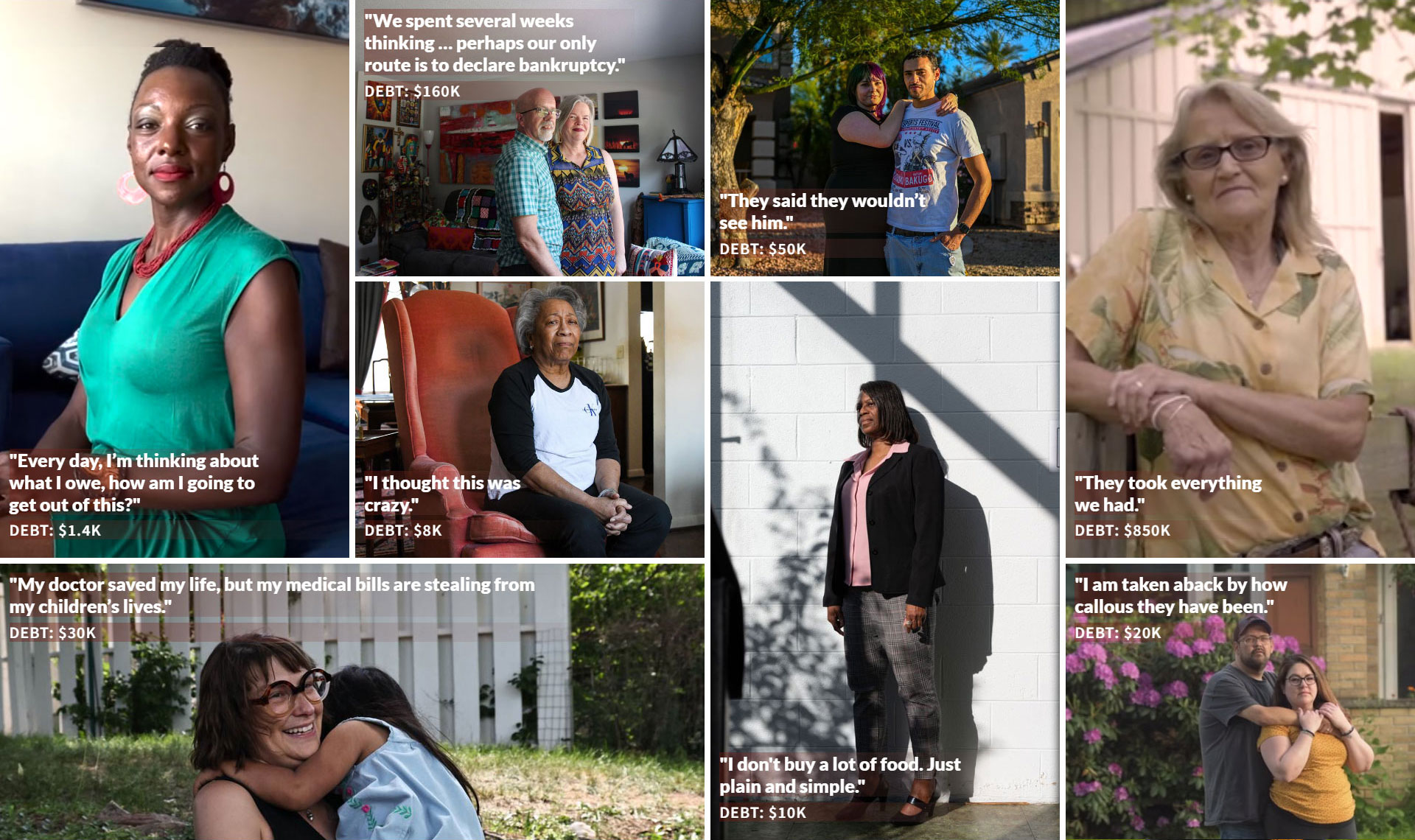
Some lost their homes. Some emptied their retirement accounts. Some struggled to feed and clothe their families. Medical debt now touches more than 100 million people in America, as the U.S. health care system pushes patients into debt on a mass scale. Debtors are from all walks of life and all corners of the country. Here are their stories ― how they got into debt, what they’ve given up for it, and how they’re living with the burden.
Loading…
Physicians, dentists, and other nonhospital providers account for more than 80% of health care debt collection cases in Connecticut courts, a CT Mirror-KFF Health News investigation finds.
At least eight states are considering legislation to curtail wage garnishment over unpaid medical bills, as health care costs rise and more people become underinsured.
Reversing guidance from the Biden administration, the Consumer Financial Protection Bureau concludes that states cannot bar medical debt from their residents’ credit reports.
Health care providers and debt collectors are biting from people’s paychecks to cover old medical bills. A KFF Health News investigation in Colorado shows that this aggressive collection practice is widespread even in a state considered to have strong consumer protections.
Some states are enacting medical debt laws as the Trump administration pulls back federal protections. Elsewhere, industry opposition has derailed legislation.
Moves by the Trump administration to pare back Medicaid, rescind medical debt rules, and loosen vaccine requirements threaten to increase medical bills for millions of Americans.
Undue Medical Debt is retiring unpaid medical bills for 20 million people. The debt trading company that owned them is leaving the market.
The move, which comes less than two weeks before President-elect Donald Trump is set to take office, represents a challenge to the new administration.
Patient and consumer advocates fear a new Trump administration will scale back federal efforts to expand financial protections for patients and shield them from debt.
The Biden administration has taken significant steps to address a problem that burdens 100 million people in America, but gains would be jeopardized by a Trump win, advocates say.
In red and blue states, state lawmakers from both parties are expanding protections for patients burdened by medical debt.
New California legislation will bar unpaid medical bills from showing up on consumer credit reports starting in January. However, the banking industry muscled in eleventh-hour amendments that weakened the protections for patients, the bill’s lead sponsor says.
The state has among the highest levels of medical debt in the country, data shows.
State officials threatened to withhold public money from hospitals, pioneering a strategy that could become a national model.
A decades-old manufacturing company opened a clinic and made primary care and prescriptions free for employees and their families.
The Consumer Financial Protection Bureau proposed federal regulations that would prevent unpaid medical bills from being counted on consumers’ credit reports.
Most U.S. hospitals aggressively pursue patients for unpaid bills. One New York hospital system decided to work with them instead.
Millions of new parents in the U.S. are swamped by medical debt during and after pregnancy, forcing many to cut back on food, clothing, and other essentials.
Colorado is ahead of the curve on policies to prevent medical debt, but the gap between the debt load in places inhabited primarily by people of color versus non-Hispanic white residents is greater than the national average.
The Consumer Financial Protection Bureau, created after the Great Recession of 2007-09, has increasingly started policing the health care system.
New York City is the latest jurisdiction to buy and forgive a backlog of unpaid medical bills for its residents. Local governments across the country, including in the Chicago area, are doing the same to reduce debt burdens for lower-income residents.
Hospitals nationwide face growing scrutiny over how they secure payment from patients, but at one community hospital, the debt collection machine has been quietly humming along for decades.
An award-winning project by KFF Health News and NPR found that at least 100 million people in the United States are saddled with medical bills they cannot pay — and exposed a health care system that systematically pushes people into debt.
A chronic health diagnosis and medical debt reordered Sharon Woodward’s life.
As credit rating agencies have removed small unpaid medical bills from consumer credit, scores have gone up, a new study finds.
The White House said the Consumer Financial Protection Bureau will develop new regulations that would prevent unpaid medical bills from being counted on credit reports.
An analysis of court records by the state treasurer and Duke researchers finds Atrium Health, originally a public hospital system, accounted for almost a third of the legal actions against North Carolina patients over roughly five years.
Within two years of North Carolina’s public university system going into business with AccessOne to finance patients’ payment plans, nearly half of its patients were in loans that charged interest. As federal scrutiny increases on lenders, KFF Health News is sharing that contract and others obtained through public records requests.
Doctors and hospitals hold an exalted position in American life, retaining public confidence even as other institutions such as government, law enforcement, and the media are losing people’s trust. But with health care debt out of hand, medical providers risk their good standing.
Kristie Fields, a cancer patient in Virginia, was urged to go public to seek financial help. She worried about feeding hurtful stereotypes.
In a new report, Human Rights Watch urges stronger federal and state action to hold hospitals to account for a medical debt crisis that now burdens more than 100 million Americans.
The “Diabetes Belt,” as defined by the Centers for Disease Control and Prevention, comprises 644 mostly Southern counties where diabetes rates are high. Of those counties, KFF Health News and NPR found, more than half also have high levels of medical debt.
Americans paid an estimated $1 billion in deferred interest on medical debt in just three years, the Consumer Financial Protection Bureau reports. The agency warns against medical credit cards, which are often pitched right in doctors’ offices.
Consumer and patient advocates push for new federal rules to protect Americans from debt collectors and force hospitals to make financial assistance more accessible.
A youth mental health crisis and a shortage of therapists and other care providers who take insurance are pushing many families into financial ruin. But it’s rarely acknowledged as medical debt.
New policies to prevent unpaid medical bills from harming people’s credit scores are on the way. But the concessions made by top credit reporting companies may fall short for those with the largest debt — especially Black Americans in the South.
Nonprofit RIP Medical Debt buys up unpaid hospital bills plaguing low-income patients and frees them from having to pay.
Medical bills can add stress to the already stressful experience of dealing with a medical crisis. And if you can’t pay those bills, they can linger, wreaking havoc on your financial goals and credit. Here’s how to protect yourself.
Medical debt is most prevalent in the Southeast, where states have not expanded Medicaid and have few consumer protection laws. Now, North Carolina is considering two bills that could change that, making the state a leader in protecting patients from high medical bills.
Marcus and Allyson Ward explain to “CBS Mornings” how the premature birth of their twins left them with $80,000 in medical debt. A new KHN-NPR investigation reveals they are among 100 million people afflicted financially by the U.S. health system.
“Diagnosis: Debt” is a reporting partnership between KFF Health News and NPR exploring the scale, impact, and causes of medical debt in America.
The series draws on original polling by KFF, court records, federal data on hospital finances, contracts obtained through public records requests, data on international health systems, and a yearlong investigation into the financial assistance and collection policies of more than 500 hospitals across the country.
Additional research was conducted by the Urban Institute, which analyzed credit bureau and other demographic data on poverty, race, and health status for KFF Health News to explore where medical debt is concentrated in the U.S. and what factors are associated with high debt levels.
The JPMorgan Chase Institute analyzed records from a sampling of Chase credit card holders to look at how customers’ balances may be affected by major medical expenses. And the CED Project, a Denver nonprofit, worked with KFF Health News on a survey of its clients to explore links between medical debt and housing instability.
KFF Health News journalists worked with KFF public opinion researchers to design and analyze the “KFF Health Care Debt Survey.” The survey was conducted Feb. 25 through March 20, 2022, online and via telephone, in English and Spanish, among a nationally representative sample of 2,375 U.S. adults, including 1,292 adults with current health care debt and 382 adults who had health care debt in the past five years. The margin of sampling error is plus or minus 3 percentage points for the full sample and 3 percentage points for those with current debt. For results based on subgroups, the margin of sampling error may be higher.
Reporters from KFF Health News and NPR also conducted hundreds of interviews with patients across the country; spoke with physicians, health industry leaders, consumer advocates, debt lawyers, and researchers; and reviewed scores of studies and surveys about medical debt.
Noam N. Levey
Aneri Pattani
Bram Sable-Smith
Megan Kalata
Anna Back
Margaret Ferguson
Amber Cole
Yuki Noguchi, NPR
Robert Benincasa, NPR
Nick McMillan, NPR
Anna Werner, CBS News
Juweek Adolphe
Alyson Hurt, NPR
Daniel Wood, NPR
Oona Tempest
Jesse Zhang
Heather Ainsworth
Carlos Bernate
Laura Buckman
Jamar Coach
Logan Cyrus
Pasquale D’Angiolillo
Taylor Glascock
Darren Hauck
Dawnee Lebeau
Ash Ponders
Eamon Queeney
Juan Diego Reyes
Julia Robinson
Olivia Sun
Kelly Johnson
Taunya English
Terry Byrne
Eric Harkleroad
Kathleen Hayden
David Hicks
Lynne Shallcross
Lydia Zuraw
Paula Andalo
Mary Agnes Carey
Rebecca Adams
Ngoc Nguyen
Carmel Wroth, NPR
Jane Greenhalgh, NPR
Meredith Rizzo, NPR
Nicole Keller, CBS News
Chaseedaw Giles
Hannah Norman
Tarena Lofton
Krishna Sharma
Matt Adams, NPR
© 2026 KFF