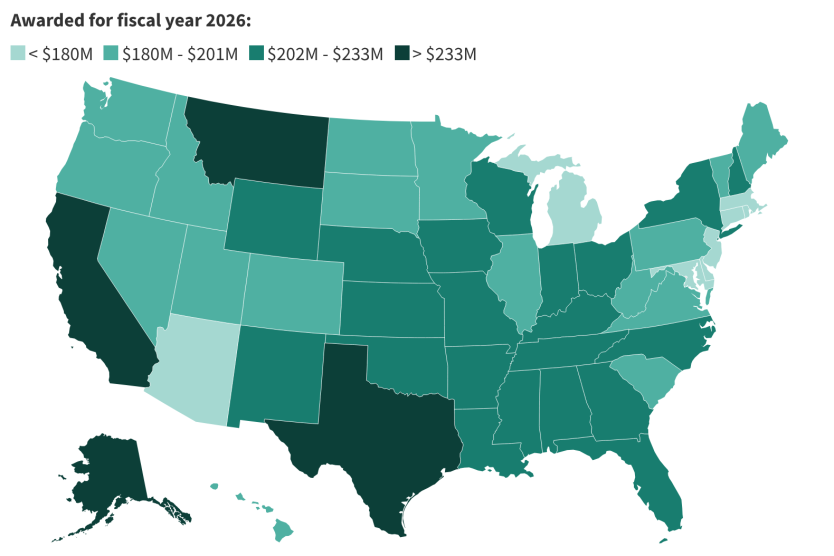
Tracking State Rural Health Transformation Plans
KFF Health News is working to collect and post approved plans as more states respond to emails and public records requests for their documents.
The independent source for health policy research, polling, and news.
KFF Health News covers the health issues facing people who live in America’s rural reaches.
KFF Health News is working to collect and post approved plans as more states respond to emails and public records requests for their documents.
261-280 of 829 results
In the waning days of the Biden administration, the Labor Department added ovarian, uterine, cervical, and breast cancer coverage for wildland firefighters. It’s unclear whether the new protections will stick under Trump.
Nevada’s budget debate highlights how uncertainty over funding for federal safety net programs may lead some officials to turn to opioid settlement dollars to make up the difference.
State lawmakers appear ready to preserve the state’s Medicaid expansion program without knowing what federal changes might be in store.
Health officials expect a measles outbreak in West Texas to exceed 100 cases because of low vaccination rates and undetected infections. Vaccine misinformation and new laws may make such situations more common and harder to contain.
A decision about how to spend settlement funds in Carter County, Kentucky, which was hit hard by the opioid epidemic, offers a window into the choices that surround this windfall.
States are required to claw back health care costs from the estates of many Medicaid recipients. Some, including Iowa, are particularly aggressive in their pursuit.
Pain MD, which once ran as many as 20 clinics across three states, gave chronic-pain patients about 700,000 total injections near their spines, according to court documents. Last year, federal prosecutors proved at trial that the shots were medically unnecessary and part of an extensive fraud scheme.
KFF Health News journalists made the rounds on national and local media recently to discuss topical stories. Here’s a collection of their appearances.
The town of Havana, Florida, is seeking a family doctor to practice in the rural community. Incentives include rent-free office space with medical equipment owned by the town. With a physician shortage hitting small communities hard, town leaders put want ads in newspapers and on social media.
The current strain of bird flu is spreading from wildlife and livestock to house cats. To keep pets healthy, many virologists and veterinarians say, house cats shouldn’t eat raw food and should be kept indoors. Despite no known cases of H5N1 transmission between cats and people, some public health agencies and virologists are warning cat owners to be mindful of the theoretical risks to the health of humans in their households if a pet gets sick.
More than 60,000 people bleed to death every year in the United States. Many of those deaths occur before the patient reaches a trauma center where blood transfusions can be given.
Tools used to contain previous bird flu outbreaks aren’t working this time, experts say. The virus has sickened at least 67 people in the U.S. and killed one, with egg producers begging for a new approach. “I call this virus a terrorist,” said one egg farmer, who lost 6.5 million birds to H5N1 in two weeks.
The Montana health department says the Board of Public Assistance is redundant and a bureaucratic hurdle that helps few people. Current and former board representatives say the rare cases in which the panel helps people are important.
The MiSalud app enables Spanish-speaking users in the U.S. to meet virtually with health professionals in Mexico via a smartphone app. At Taylor Farms in Salinas, California, the novel program has been a hit.
State legislatures nationwide, including several in the South, are spending millions to improve rural health outcomes and access. For years, though, most Southern states have refused billions of federal dollars to provide public health insurance to more low-income adults. That isn’t likely to change with Trump back in office.
Unsure how to help the troubled psychiatric facility, legislators look to shore up other parts of the state’s mental health system.
An unprecedented freeze on the agency’s Morbidity and Mortality Weekly Report sparks new concerns about political meddling in science.
Controversy over raw milk reflects the push-pull the Trump administration faces in rolling back regulations and offering consumers more choices. For now, the CDC still recommends against consuming raw milk and the FDA bans its interstate sale.
The moves under consideration include relocating a residential facility for people with developmental disabilities, renovating the state’s psychiatric hospital, and opening a new unit of the hospital in Helena.
Health leaders say a tool to boost medical coverage for Native Americans, a population that has long faced worse health outcomes than the rest of the nation, has been underused by many states and tribes since it was written into the Affordable Care Act more than a decade ago.
© 2026 KFF